Walk past your garden tulips at 9 PM and they look like a completely different plant than they did at noon. Petals pulled tight, colors muted, the whole bloom folded in on itself like a closed umbrella. By morning, everything opens again as if nothing happened. If you’ve ever caught this in action, you’ve witnessed nyctinasty – one of the most quietly fascinating behaviors in the plant world.
But here’s what stuck with me: this isn’t random. It’s not wilting, it’s not dying, and it’s not a sign that something is wrong. It’s a deliberate, rhythmic movement that certain species have been performing for millions of years. And the reasons behind it are more nuanced – and more debated – than most articles let on.
What exactly happens inside a closing flower?
The word “nyctinasty” comes from the Greek nyx (night) and nastos (pressed close). But the name only tells you when it happens, not how. The mechanics are genuinely elegant.
At the base of each petal – and in leaf-closing species, at the base of the leaf stalk – there’s a swollen region of cells called the pulvinus. Think of it as a biological hinge. When darkness falls, potassium and chloride ions shuttle out of cells on one side of the pulvinus. Water follows those ions through osmosis, and those cells lose turgor pressure. The cells on the opposite side stay plump. That differential pressure literally bends the petal inward.
Come morning, the process reverses. Light triggers ion channels to open, water floods back in, and the petals unfurl.
What makes this especially interesting is that it’s not purely a response to light. Research going back to the 18th century – the French astronomer Jean-Jacques d’Ortous de Mairan noticed it in 1729 with mimosa plants – has shown that these movements persist even in continuous darkness. The plant has an internal circadian clock. Light is the primary signal that synchronizes the rhythm, but the oscillation itself is endogenous. Remove the light cue entirely, and the opening-closing cycle continues for several days before gradually drifting out of sync.

The “why” is more complicated than you’d think
Most sources settle on one or two explanations for why flowers evolved this behavior. The real picture involves several overlapping hypotheses, and honestly, botanists still argue about which ones carry the most weight.
Pollen protection
This is the leading hypothesis. Pollen grains are vulnerable to moisture – dew, rain, and the general humidity spike that often comes after sunset. Wet pollen doesn’t transfer effectively to pollinators. By closing up, the flower shields its reproductive material through the dampest hours. A 2019 study on Crocus published in the Annals of Botany found that flowers prevented from closing had significantly lower pollen viability after a single dewy night compared to control plants that closed normally.
Thermal regulation
Closed petals create a microenvironment that can be measurably warmer than the surrounding air. For species that bloom in early spring – crocuses, tulips, certain Adonis species – this matters. The developing ovules and stamens are kept a few critical degrees above ambient temperature. Some researchers have measured a 3–5°F difference inside a closed tulip versus the outside air on a cold April night.
Pollinator economics
Here’s an angle that doesn’t get enough attention. If a flower stays open at night but its pollinators are diurnal (active during the day), then those open petals are essentially an unattended buffet for nocturnal visitors – beetles, moths, or other insects that feed on pollen and nectar without efficiently pollinating the flower. Closing eliminates the freeloaders. It’s a way of making sure the flower’s resources only go to the insects most likely to carry pollen to another bloom of the same species.
Predation and herbivory
Petals and reproductive structures are nutritious. Some researchers suggest that closing reduces the visual and olfactory signal that attracts nocturnal herbivores. A tightly closed bud is harder for a beetle to chew into than a wide-open flower. This hypothesis is harder to test directly, but it aligns with what we see in species growing in habitats with heavy insect herbivory.
Not all petal movement is nyctinasty
This is a point that gets muddled frequently. Several related phenomena look similar to the casual observer but involve different mechanisms:
- Photonasty – movement triggered directly by light intensity changes, without an underlying circadian component. The flower simply responds to brightness. If you put a photonastic flower in constant light, it stays open. A nyctinastic flower in constant light will still attempt to close on schedule.
- Thermonasty – movement driven by temperature. Tulips are partly thermonastic: warm your tulip with a heat lamp at night, and it’ll open. But research shows a circadian component layered on top of the temperature response, making tulips a hybrid case.
- Seismonasty – movement triggered by touch or vibration, like the famous sensitive plant (Mimosa pudica). Totally different trigger, though the pulvinus mechanism is similar.
The distinctions matter because they affect how your plants behave in different environments. If you grow tulips indoors under constant artificial light and steady temperature, don’t be surprised if their opening-closing rhythm becomes irregular or disappears. They need the daily swing of light and temperature to keep the clock calibrated.

Seven common nyctinastic species you can observe in your own yard
You don’t need a botanical garden for this. Many popular garden plants across USDA zones 4–9 exhibit noticeable petal movement:
- Tulips (Tulipa spp.) – One of the most dramatic closers. The response is partly temperature-driven, so you can even watch it happen in real time by bringing a cut tulip from a cool porch into a warm room.
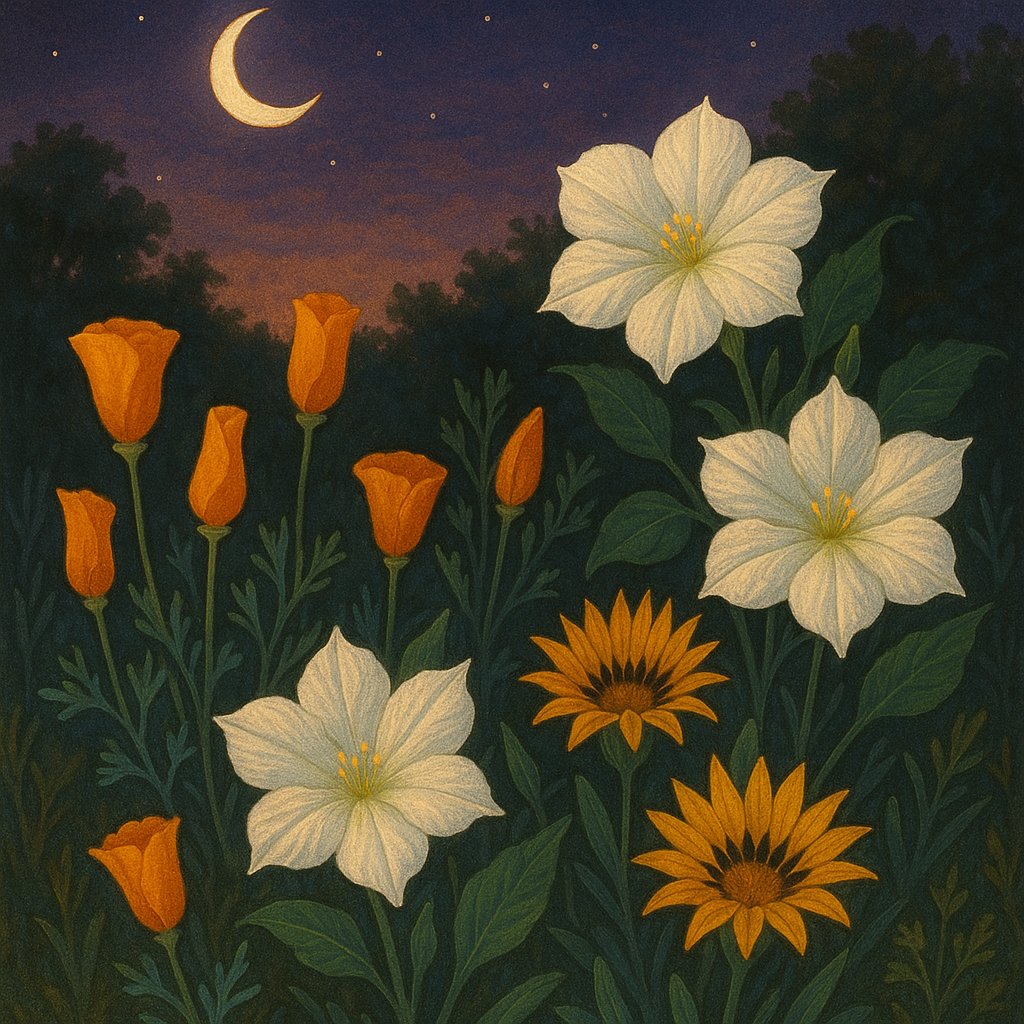
- California poppies (Eschscholzia californica) – Close tightly on cloudy days too, not just at night. A true light-responsive closer.
- Purple shamrock (Oxalis triangularis) – Both the leaves and flowers fold. The leaf movement is especially fun to watch – they droop like little sleeping umbrellas.
- Crocus (Crocus spp.) – Spring crocuses snap shut remarkably fast as shadows lengthen.
- Morning glory (Ipomoea purpurea) – Opens at dawn, spent by afternoon. Not exactly classic nighttime closing, but a clear example of light-synchronized petal behavior.
- Gazania (Gazania rigens) – Stays stubbornly shut on overcast days, which frustrates some gardeners but makes perfect evolutionary sense.
- Moss rose (Portulaca grandiflora) – Full sun only. These petals won’t budge without direct light.
What Darwin got right – and what we’re still figuring out
Charles Darwin devoted an entire book to plant movement – The Power of Movement in Plants (1880), co-authored with his son Francis. He meticulously documented the sleep movements of dozens of species and concluded that the behavior must offer some protective advantage, likely against cold. He was on the right track, but he didn’t have access to the molecular tools we have now.
Today, researchers have identified specific clock genes – like LHY and TOC1 – that regulate circadian rhythms in plants. They’ve traced the signaling pathway from photoreceptors (phytochromes and cryptochromes that sense red and blue light) down to the ion channels in the pulvinus. But significant gaps remain. We still don’t fully understand why closely related species in the same genus sometimes differ – one closes at night, the other doesn’t. And the ecological cost-benefit math is hard to pin down precisely: how much energy does the movement itself consume, and does the protection gained always outweigh that cost?
A 2021 paper in New Phytologist proposed that nyctinasty may also play a role in water conservation – closed petals reduce transpiration from the petal surface during the hours when photosynthesis isn’t happening anyway. It’s a compelling idea, especially for species in arid habitats, though more field data is needed. Ongoing work as of 2025 and into 2026 continues to refine these models, with several research groups using thermal imaging and real-time ion-flux sensors to quantify the energetic costs and benefits of petal closure under field conditions.
A simple experiment you can try this weekend
If you want to see circadian plant movement with your own eyes – and prove it’s not just a light reaction – try this with a potted Oxalis or a cut tulip:
- Place the plant in a room with a regular light-dark cycle for two days so it synchronizes.
- On the third evening, move it into a dark closet and leave it there.
- Check every few hours. You’ll notice it still opens roughly on schedule the next “morning,” even in total darkness.
- By the second or third day in constant darkness, the rhythm starts to drift – the “waking” time shifts later each cycle, usually by 30–90 minutes per day.
This tells you something profound: the plant isn’t just passively reacting to its environment. It’s keeping time internally, anticipating dawn before it arrives.
What this means for the way we think about plants
Nyctinasty challenges the default assumption that plants are static, passive organisms. They’re not. They track time, anticipate environmental changes, and execute coordinated mechanical responses. The more you observe these rhythms – really watch them – the more you start to appreciate that a garden is full of quiet, slow-motion activity that most of us walk right past.
If this topic has piqued your curiosity about the hidden lives of flowers, the team at Orlaya Flora shares a wealth of insights into plant behavior, seasonal bloom patterns, and species-specific growing guidance that goes well beyond the basics. It’s a good next stop for anyone who wants to dig deeper into what their flowers are actually doing when we’re not watching.