How to choose florist’s knives and shears: what to buy first for arranging flowers at home
The first time I tried to arrange a grocery-store bouquet at home, I used kitchen scissors. Within a week, half the stems had gone slimy and the tulips drooped like wet paper. The flowers weren’t the problem. The cut was. Crushed stem ends can’t drink properly, and bacteria love the damaged tissue. A decent cutting tool is the cheapest way to make flowers last longer and look better.
The florist’s toolbox is full of options, though, and it’s easy to overspend on things you won’t touch. This guide covers what each tool does, what to look for, and what to buy first.
Why your kitchen scissors aren’t doing the job
A flower stem is a bundle of tiny water-carrying channels. A clean, sharp cut leaves them open. Dull or wide-set blades pinch and flatten them, which slows water uptake. Woody stems such as lilac, hydrangea, and roses make this worse, because they’re tough and fibrous.
Kitchen scissors also tend to be thick at the tip and too clumsy for tight spots. Try trimming a leaf deep inside a full vase and you’ll see what I mean.
The three core tools and what each one does
Floral knife
This is the traditional choice, and many professionals still reach for it first. A short, sharp blade slices stems at an angle in a single pass, leaving a wide, clean surface for water. It’s also excellent for stripping thorns and leaves from roses and for cutting soft stems like tulips and ranunculus without crushing them.
The learning curve is real. You pull the stem against the blade with your thumb as a guide, not the other way around, and it takes a few practice rounds to feel natural. Look for a blade of about 2–3 inches, a non-slip handle, and either a folding mechanism that locks or a sheath. Carbon steel takes a keen edge but needs drying after use. Stainless is lower-maintenance.
Floral shears
Shears are the best starting point for most beginners. They’re forgiving, quick, and safe. Good ones have short, strong, slightly serrated or micro-serrated blades that grip slippery stems. Many come with a small notch near the pivot for cutting thin wire or stripping thorns.
Choose bypass shears, where two blades pass each other like scissors, rather than anvil types. Bypass blades slice cleanly and keep stem channels open. Anvil blades press down onto a flat surface and tend to crush.
Heavy-duty pruners or snips
Roses, branches, flowering quince, and eucalyptus stems can be thicker than a pencil. For those, you’ll want a small pair of bypass pruners. Using floral shears on woody branches is the quickest way to spring the blades out of alignment.
Small ribbon snips or micro-tip snips are a nice extra for trimming leaves, fine foliage, and delicate blooms, but they come later.

What to buy first: a practical order
- Floral shears. They handle about 80 percent of home arranging: grocery bouquets, farmers market stems, garden flowers.
- A small floral knife. Add it once you’re comfortable and want faster, cleaner cuts, especially for roses and soft stems.
- Bypass pruners. Buy these when you start working with branches or garden roses.
- Snips. Optional, for detail work and wreaths or tight arrangements.
If you only buy one tool, make it shears. If you cut your own garden flowers, a pair of pruners may deserve first place.
How to judge quality without a lab
- Fit in your hand. Open and close them twenty times. If your hand cramps, you’ll stop using them. Left-handed designs exist, and they matter.
- Blade alignment. Look at the blades from the side. There should be no visible gap when closed.
- Replaceable or sharpenable parts. Good shears can be sharpened and tightened rather than thrown away.
- Handle grip. Rubberized or textured handles help when your hands are wet, which is always.
- Weight. Heavy tools tire your wrist in a long session. Light ones can feel flimsy. Aim for a balance you barely notice.
Price is a rough guide only. Reliable shears from established garden and floral brands commonly run from about $15 to $40 in the US. Professional-grade pairs cost more, but a home arranger rarely needs them.
Habits that matter as much as the tool
A sharp blade can still be undone by sloppy handling. A few habits I picked up from florists I’ve watched work:
- Cut stems at a 45-degree angle, under running water or immediately before placing them in a vase.
- Clean the blades with rubbing alcohol or hot soapy water between sessions. Dirty blades carry bacteria straight into fresh cuts.
- Don’t use your flower tools on wire, tape, or packaging. Wire dents blades fast. Keep a cheap pair of craft scissors for that.
- Dry tools completely before storing, and wipe carbon steel with a drop of light oil now and then.
- Sharpen once or twice a year with a fine whetstone or a sharpening service. Dull blades are the most common reason for short vase life.
Start small, cut clean
You don’t need a full professional kit to arrange flowers well at home. A solid pair of bypass floral shears, kept clean and sharp, will carry you through months of bouquets. Add a knife when your technique grows, and pruners when you start working with branches or garden stems.
Next time you bring flowers home, try an experiment: cut half the stems with your old scissors and half with a sharp, clean tool, then compare them after five days. The difference tends to be convincing, and it’s the best way to learn what a good tool is worth to you.
Choosing the best international flower delivery service for your needs
My cousin spent three days trying to get a birthday bouquet to her college roommate studying abroad in Lisbon. She tried a big-name American florist site, watched the price double at checkout with “international handling fees,” then got an email two days later saying the order couldn’t be fulfilled in that postal code. It’s a common story. Sending flowers across borders sounds simple until you actually try it, and that’s when most people discover how fragmented and confusing this industry really is.
Why sending flowers overseas isn’t like ordering a local bouquet
Domestic flower delivery in the US runs on a pretty mature network – wire services, regional growers, same-day courier partnerships. Cross international borders, though, and you’re suddenly dealing with customs regulations, different flower availability by climate and season, currency conversion, and local florists who may not even use the same online booking systems as US-based platforms. A rose that’s in full bloom and cheap in Colombia might be a luxury import in Japan. A florist in rural France might not have a website at all – they rely on regional wholesalers and phone orders.
This is why picking the right service matters so much more than people expect. It’s not just about pretty pictures on a website. It’s about whether the company actually has boots-on-the-ground relationships with florists in the destination country, or whether they’re just relaying your order through three middlemen and hoping for the best.
What actually separates a reliable service from a risky one
Local florist networks versus drop-shipping
Some platforms genuinely partner with independent florists in the destination city – meaning your bouquet is arranged fresh, locally, on the day of delivery. Others act more like brokers, forwarding your order to whichever supplier is cheapest that week, with no direct accountability if something goes wrong. I’ve found that asking a simple question before ordering – “who actually arranges and delivers this?” – tends to reveal a lot. If a company can’t answer clearly, that’s a red flag.
Transparent pricing (and the fees nobody mentions upfront)
Watch out for services that show one price on the search page and add a “service fee,” “delivery surcharge,” and “currency conversion fee” only at the final checkout screen. This is one of the most common complaints among people who’ve tried ordering internationally. A legitimate operator will show a final, all-in price before you commit, in your home currency, without surprise math at the end.

Delivery guarantees that mean something
“Same-day delivery” claims are easy to make and hard to verify from another continent. Look for services that specify actual delivery windows, offer tracking or confirmation photos, and have a clear refund or redelivery policy if the recipient isn’t home or the flowers arrive damaged. Time zones matter here too – a company promising same-day delivery to Sydney needs to actually understand what “same day” means when it’s already tomorrow there.
| Factor | Reliable service | Risky service |
|---|---|---|
| Florist relationship | Direct partnership, verified locally | Unknown third-party reseller |
| Pricing | All-in price shown upfront | Hidden fees at checkout |
| Delivery proof | Photo confirmation or tracking | No verification offered |
| Customer support | Reachable across time zones | Email-only, slow response |
A few things I’ve learned the hard way
- Always check what flowers are actually in season in the destination country – a “custom” bouquet request for tulips in Manila in August is going to be a problem no matter who you order from.
- Confirm the recipient’s full address format matches local conventions; postal systems abroad don’t always follow the US street-number-then-name pattern, and a florist may not catch the error until delivery day.
- Ask about substitution policies. Nearly every florist reserves the right to swap flowers of similar value if something isn’t available – this isn’t a scam, it’s standard practice, but you should know it’s coming.
Kind of a side note, but worth mentioning: services that specialize specifically in cross-border delivery tend to handle these nuances better than general e-commerce florists that just added an “international” tab to their site. When my sister was researching this after her own delivery mishap, she ended up comparing a handful of dedicated platforms, and it became clear that the ones treating international delivery as their core business – not an afterthought – were far more consistent. That’s really the heart of choosing a best international flower delivery service for your specific situation: match the platform’s actual specialty to what you need, rather than assuming every florist website works the same way everywhere.
Matching the service to the occasion
A sympathy arrangement needing next-day delivery in a small German town has very different requirements than a birthday bouquet for someone in central Tokyo who can receive same-day courier service. For remote or smaller towns, prioritize services with wide local florist networks rather than big-city courier fleets. For major metro areas, same-day guarantees and photo confirmation become realistic expectations you can actually hold the company to.
Where this leaves you
Sending flowers internationally doesn’t have to be a gamble. The key is looking past the homepage photos and checking for real local partnerships, honest pricing, and delivery accountability. Ask questions before you order, not after something goes wrong. If you’re planning a delivery for an upcoming birthday, anniversary, or just because, take twenty minutes to compare a couple of options using the criteria above – it’s a small step that saves a lot of frustration later.
Why some flowers close their petals at night (nyctinasty)
Walk past your garden tulips at 9 PM and they look like a completely different plant than they did at noon. Petals pulled tight, colors muted, the whole bloom folded in on itself like a closed umbrella. By morning, everything opens again as if nothing happened. If you’ve ever caught this in action, you’ve witnessed nyctinasty – one of the most quietly fascinating behaviors in the plant world.
But here’s what stuck with me: this isn’t random. It’s not wilting, it’s not dying, and it’s not a sign that something is wrong. It’s a deliberate, rhythmic movement that certain species have been performing for millions of years. And the reasons behind it are more nuanced – and more debated – than most articles let on.
What exactly happens inside a closing flower?
The word “nyctinasty” comes from the Greek nyx (night) and nastos (pressed close). But the name only tells you when it happens, not how. The mechanics are genuinely elegant.
At the base of each petal – and in leaf-closing species, at the base of the leaf stalk – there’s a swollen region of cells called the pulvinus. Think of it as a biological hinge. When darkness falls, potassium and chloride ions shuttle out of cells on one side of the pulvinus. Water follows those ions through osmosis, and those cells lose turgor pressure. The cells on the opposite side stay plump. That differential pressure literally bends the petal inward.
Come morning, the process reverses. Light triggers ion channels to open, water floods back in, and the petals unfurl.
What makes this especially interesting is that it’s not purely a response to light. Research going back to the 18th century – the French astronomer Jean-Jacques d’Ortous de Mairan noticed it in 1729 with mimosa plants – has shown that these movements persist even in continuous darkness. The plant has an internal circadian clock. Light is the primary signal that synchronizes the rhythm, but the oscillation itself is endogenous. Remove the light cue entirely, and the opening-closing cycle continues for several days before gradually drifting out of sync.

The “why” is more complicated than you’d think
Most sources settle on one or two explanations for why flowers evolved this behavior. The real picture involves several overlapping hypotheses, and honestly, botanists still argue about which ones carry the most weight.
Pollen protection
This is the leading hypothesis. Pollen grains are vulnerable to moisture – dew, rain, and the general humidity spike that often comes after sunset. Wet pollen doesn’t transfer effectively to pollinators. By closing up, the flower shields its reproductive material through the dampest hours. A 2019 study on Crocus published in the Annals of Botany found that flowers prevented from closing had significantly lower pollen viability after a single dewy night compared to control plants that closed normally.
Thermal regulation
Closed petals create a microenvironment that can be measurably warmer than the surrounding air. For species that bloom in early spring – crocuses, tulips, certain Adonis species – this matters. The developing ovules and stamens are kept a few critical degrees above ambient temperature. Some researchers have measured a 3–5°F difference inside a closed tulip versus the outside air on a cold April night.
Pollinator economics
Here’s an angle that doesn’t get enough attention. If a flower stays open at night but its pollinators are diurnal (active during the day), then those open petals are essentially an unattended buffet for nocturnal visitors – beetles, moths, or other insects that feed on pollen and nectar without efficiently pollinating the flower. Closing eliminates the freeloaders. It’s a way of making sure the flower’s resources only go to the insects most likely to carry pollen to another bloom of the same species.
Predation and herbivory
Petals and reproductive structures are nutritious. Some researchers suggest that closing reduces the visual and olfactory signal that attracts nocturnal herbivores. A tightly closed bud is harder for a beetle to chew into than a wide-open flower. This hypothesis is harder to test directly, but it aligns with what we see in species growing in habitats with heavy insect herbivory.
Not all petal movement is nyctinasty
This is a point that gets muddled frequently. Several related phenomena look similar to the casual observer but involve different mechanisms:
- Photonasty – movement triggered directly by light intensity changes, without an underlying circadian component. The flower simply responds to brightness. If you put a photonastic flower in constant light, it stays open. A nyctinastic flower in constant light will still attempt to close on schedule.
- Thermonasty – movement driven by temperature. Tulips are partly thermonastic: warm your tulip with a heat lamp at night, and it’ll open. But research shows a circadian component layered on top of the temperature response, making tulips a hybrid case.
- Seismonasty – movement triggered by touch or vibration, like the famous sensitive plant (Mimosa pudica). Totally different trigger, though the pulvinus mechanism is similar.
The distinctions matter because they affect how your plants behave in different environments. If you grow tulips indoors under constant artificial light and steady temperature, don’t be surprised if their opening-closing rhythm becomes irregular or disappears. They need the daily swing of light and temperature to keep the clock calibrated.

Seven common nyctinastic species you can observe in your own yard
You don’t need a botanical garden for this. Many popular garden plants across USDA zones 4–9 exhibit noticeable petal movement:
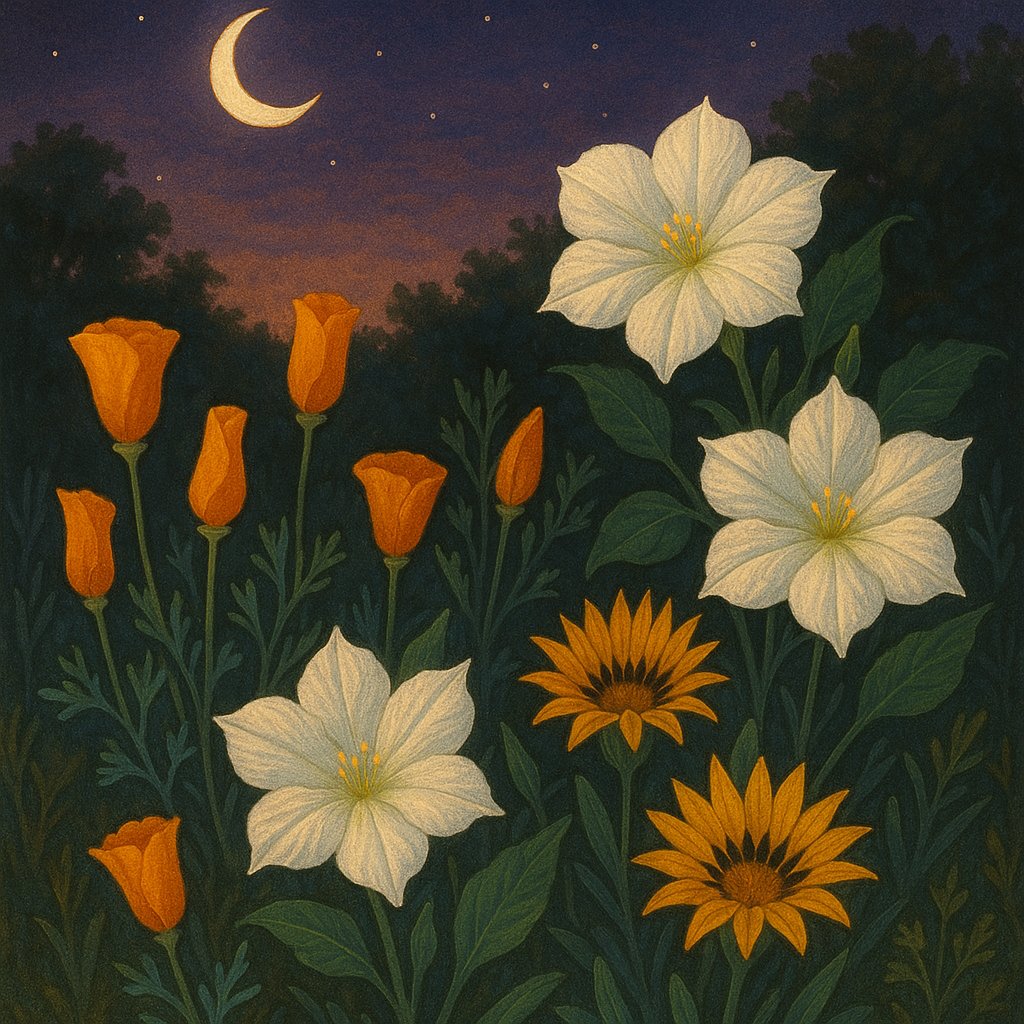
- Tulips (Tulipa spp.) – One of the most dramatic closers. The response is partly temperature-driven, so you can even watch it happen in real time by bringing a cut tulip from a cool porch into a warm room.
- California poppies (Eschscholzia californica) – Close tightly on cloudy days too, not just at night. A true light-responsive closer.
- Purple shamrock (Oxalis triangularis) – Both the leaves and flowers fold. The leaf movement is especially fun to watch – they droop like little sleeping umbrellas.
- Crocus (Crocus spp.) – Spring crocuses snap shut remarkably fast as shadows lengthen.
- Morning glory (Ipomoea purpurea) – Opens at dawn, spent by afternoon. Not exactly classic nighttime closing, but a clear example of light-synchronized petal behavior.
- Gazania (Gazania rigens) – Stays stubbornly shut on overcast days, which frustrates some gardeners but makes perfect evolutionary sense.
- Moss rose (Portulaca grandiflora) – Full sun only. These petals won’t budge without direct light.
What Darwin got right – and what we’re still figuring out
Charles Darwin devoted an entire book to plant movement – The Power of Movement in Plants (1880), co-authored with his son Francis. He meticulously documented the sleep movements of dozens of species and concluded that the behavior must offer some protective advantage, likely against cold. He was on the right track, but he didn’t have access to the molecular tools we have now.
Today, researchers have identified specific clock genes – like LHY and TOC1 – that regulate circadian rhythms in plants. They’ve traced the signaling pathway from photoreceptors (phytochromes and cryptochromes that sense red and blue light) down to the ion channels in the pulvinus. But significant gaps remain. We still don’t fully understand why closely related species in the same genus sometimes differ – one closes at night, the other doesn’t. And the ecological cost-benefit math is hard to pin down precisely: how much energy does the movement itself consume, and does the protection gained always outweigh that cost?
A 2021 paper in New Phytologist proposed that nyctinasty may also play a role in water conservation – closed petals reduce transpiration from the petal surface during the hours when photosynthesis isn’t happening anyway. It’s a compelling idea, especially for species in arid habitats, though more field data is needed. Ongoing work as of 2025 and into 2026 continues to refine these models, with several research groups using thermal imaging and real-time ion-flux sensors to quantify the energetic costs and benefits of petal closure under field conditions.
A simple experiment you can try this weekend
If you want to see circadian plant movement with your own eyes – and prove it’s not just a light reaction – try this with a potted Oxalis or a cut tulip:
- Place the plant in a room with a regular light-dark cycle for two days so it synchronizes.
- On the third evening, move it into a dark closet and leave it there.
- Check every few hours. You’ll notice it still opens roughly on schedule the next “morning,” even in total darkness.
- By the second or third day in constant darkness, the rhythm starts to drift – the “waking” time shifts later each cycle, usually by 30–90 minutes per day.
This tells you something profound: the plant isn’t just passively reacting to its environment. It’s keeping time internally, anticipating dawn before it arrives.
What this means for the way we think about plants
Nyctinasty challenges the default assumption that plants are static, passive organisms. They’re not. They track time, anticipate environmental changes, and execute coordinated mechanical responses. The more you observe these rhythms – really watch them – the more you start to appreciate that a garden is full of quiet, slow-motion activity that most of us walk right past.
If this topic has piqued your curiosity about the hidden lives of flowers, the team at Orlaya Flora shares a wealth of insights into plant behavior, seasonal bloom patterns, and species-specific growing guidance that goes well beyond the basics. It’s a good next stop for anyone who wants to dig deeper into what their flowers are actually doing when we’re not watching.
Why some flowers bloom only at night
Picture this: it’s a warm July evening in your backyard. The sun has just dipped below the horizon, the crickets are warming up, and suddenly – a flash of white catches your eye. A tightly wound bud you’ve been watching for days is finally unfurling, petal by petal, releasing a scent so sweet it stops you mid-step. By morning, the flower will be gone.
I’ve watched this happen with a night-blooming cereus on my patio, and honestly, it felt like witnessing something that wasn’t meant to be seen. But here’s the thing – it absolutely was. Just not by me. That flower was performing for an entirely different audience, and every detail of its design – the color, the timing, the fragrance – was calibrated for creatures that come alive after dark.
So why do some plants skip the sunlit hours entirely? The answer is more layered than most articles will tell you. It’s not just about pollinators. It’s about survival strategy, water economics, evolutionary gambles, and a biological clock ticking inside every cell.
The pollinator argument – and why it’s only half the story
Most explanations start and stop here: nocturnal flowers bloom at night to attract nocturnal pollinators. Moths, bats, certain beetles. That’s true, but it undersells what’s actually happening.
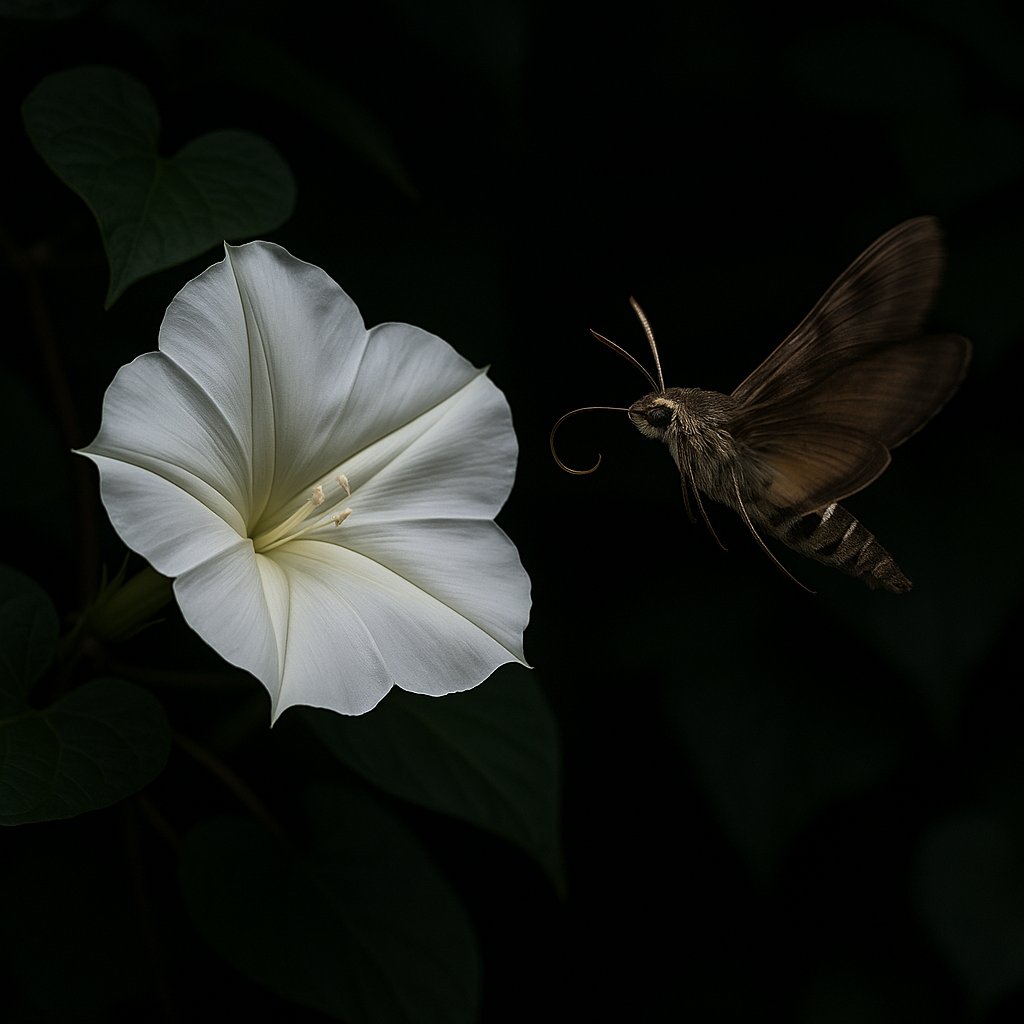
Think about the daytime pollination market. It’s crowded. Bees, butterflies, hummingbirds, flies – they’re all competing for the same flowers, and those flowers are competing for the same pollinators. Now imagine a plant that sidesteps this entire frenzy by opening shop when the competition is asleep. Fewer pollinators are available at night, sure, but the ones that do show up – hawk moths, sphinx moths, nectar-feeding bats – have far fewer options. The relationship becomes almost exclusive.
This is what biologists call temporal niche partitioning. Instead of competing in a saturated daytime marketplace, night-blooming plants carved out their own shift. And they adapted every aspect of their biology to dominate it.
How nocturnal flowers “speak” to their pollinators
Color is the first giveaway. Notice how night-blooming flowers tend to be white, pale yellow, or cream? In low light, these colors reflect even faint moonlight, making the blooms visible to moths navigating by sight. Dark reds and blues – so attractive to daytime bees – would simply vanish in the darkness.
Then there’s fragrance. Nocturnal flowers don’t just smell nice – they are scent powerhouses. Evening primrose, tuberose, night-blooming jasmine – these plants pump out volatile organic compounds at concentrations that would be overkill during the day. Hawk moths can detect certain floral scents from over a quarter mile away. The flower doesn’t need to be seen first. It needs to be smelled first.
And the shapes tell a story too. Long, tubular corollas are common among night bloomers because they match the long proboscis of sphinx moths. The flower and the pollinator evolved together, each shaping the other over millions of years.
The clock inside the petals
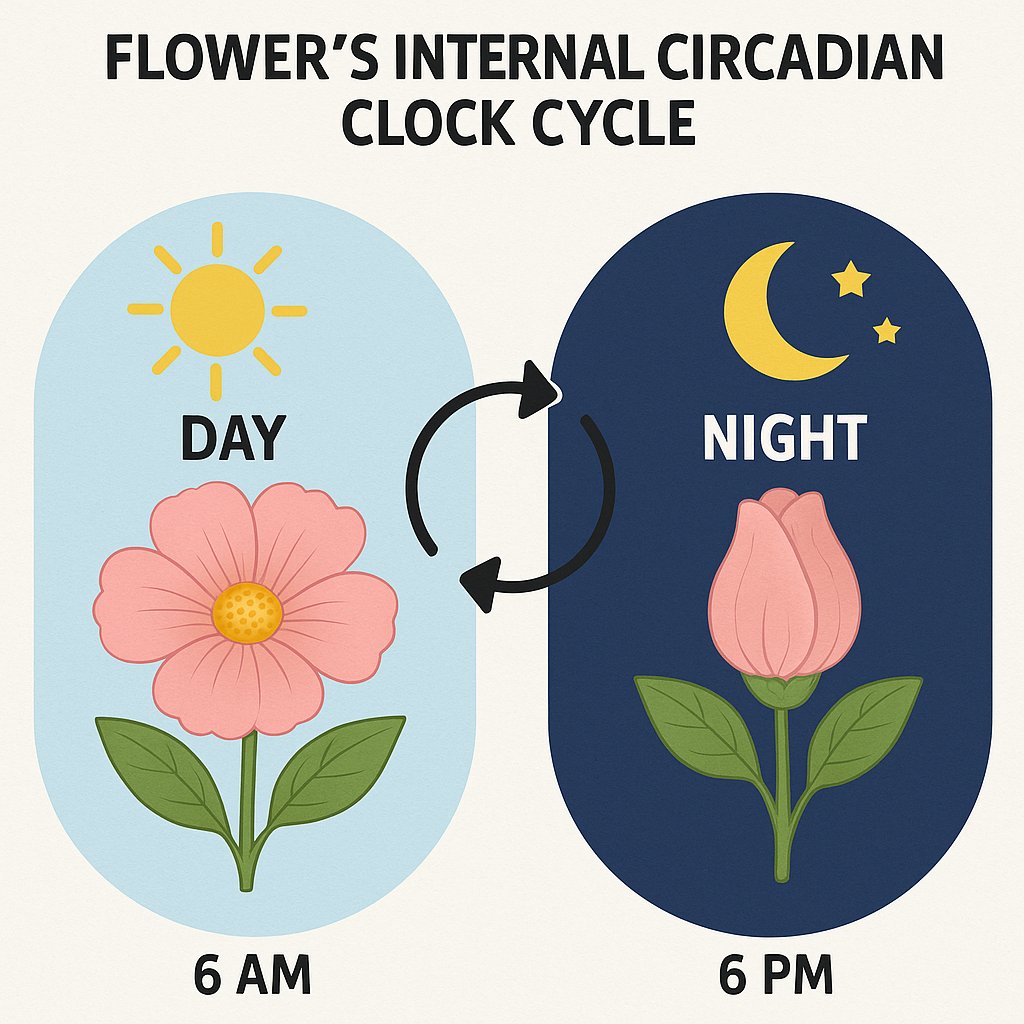
Here’s something rarely explained in depth: flowers don’t simply “react” to darkness. They anticipate it. The mechanism is governed by circadian rhythms – internal biological clocks that cycle roughly every 24 hours, just like in humans.
In plants, these clocks are driven by a set of proteins that rise and fall in concentration throughout the day. Key among them are components of what scientists call the TOC1-CCA1 feedback loop (named after the genes involved in Arabidopsis research but present in various forms across flowering plants). Light resets this clock each morning, but the clock itself keeps running even in constant darkness – proving it’s truly internal, not just a reaction to external light.
What this means practically: a night-blooming cereus “knows” when evening is approaching hours before the sun sets. The biochemical cascade that softens cell walls in the petals, inflates them with water, and triggers scent production begins well in advance. By the time twilight arrives, the flower is ready.
Temperature and humidity play supporting roles
There’s a less-discussed but critical factor: water conservation. Many nocturnal bloomers evolved in arid or semi-arid environments – deserts, dry tropical forests, Mediterranean climates. Opening a flower is an act of water loss. Petals are essentially exposed moist tissue, and during hot, dry daytime hours, evaporation is ruthless.
By blooming at night – when temperatures drop, humidity rises, and evapotranspiration slows – these plants conserve precious moisture. The queen of the night cactus (Epiphyllum oxypetalum) is a perfect example. Native to Central American forests and adapted to dry conditions, it blooms for a single night, closes by dawn, and avoids the punishing midday heat entirely.
This isn’t just about the flower itself. Pollen viability also suffers in extreme heat. Some studies suggest that pollen grains from night-blooming species remain fertile longer because they avoid UV radiation and thermal stress. The plant isn’t just protecting petals – it’s protecting its reproductive future.
Night bloomers you might already have in your garden
Let’s move from theory to the plants themselves. Here are a few worth knowing – some common, some you might not have heard of:
- Moonflower (Ipomoea alba) – A vigorous vine across USDA zones 10–12 (annual elsewhere). Its 6-inch white trumpets open at dusk and close by mid-morning. Easy to grow from seed after nicking the hard coat.
- Evening primrose (Oenothera biennis) – Native to North America and often considered a weed, which is a shame. Its yellow flowers pop open in seconds at twilight – fast enough to actually watch in real time.
- Night-blooming jasmine (Cestrum nocturnum) – The fragrance on this one is almost too much. One bush can perfume an entire yard. Popular in the South but tender below zone 9.
- Four o’clocks (Mirabilis jalapa) – Not strictly nocturnal but crepuscular – they open in late afternoon and stay open through the night. Multicolored, carefree, and often self-seeding aggressively.
- Night-blooming cereus (multiple genera) – The dramatic one. Blooms once a year, for one night. Communities in the Southwest throw “cereus watching parties” to catch the event.
- Dragon fruit cactus (Hylocereus undatus) – Yes, the fruit you buy at the grocery store comes from a night-blooming cactus. The flowers are enormous, fragrant, and last a single night.
One species that deserves more attention is Zaluzianskya capensis, commonly called night phlox or “midnight candy.” Tiny star-shaped blooms, maroon on the back, white on the face, with a scent that genuinely smells like vanilla mixed with honey. It’s underused in American gardens and thrives in containers.
What light pollution is doing to nocturnal blooms
This is the angle almost nobody covers – and it matters.
Research published in Nature in 2017 found that artificial light at night (ALAN) reduced pollinator visits to certain nocturnal flowers by 62%. The light disrupts moth navigation, confuses circadian cues for both plants and insects, and can even suppress scent production in some species. A cabbage thistle study in Switzerland showed that fruit set dropped by 13% under artificial light conditions. Since that initial research, follow-up studies through 2025 have only reinforced the concern, with urban ecologists now listing ALAN as a measurable threat to plant-pollinator networks worldwide.
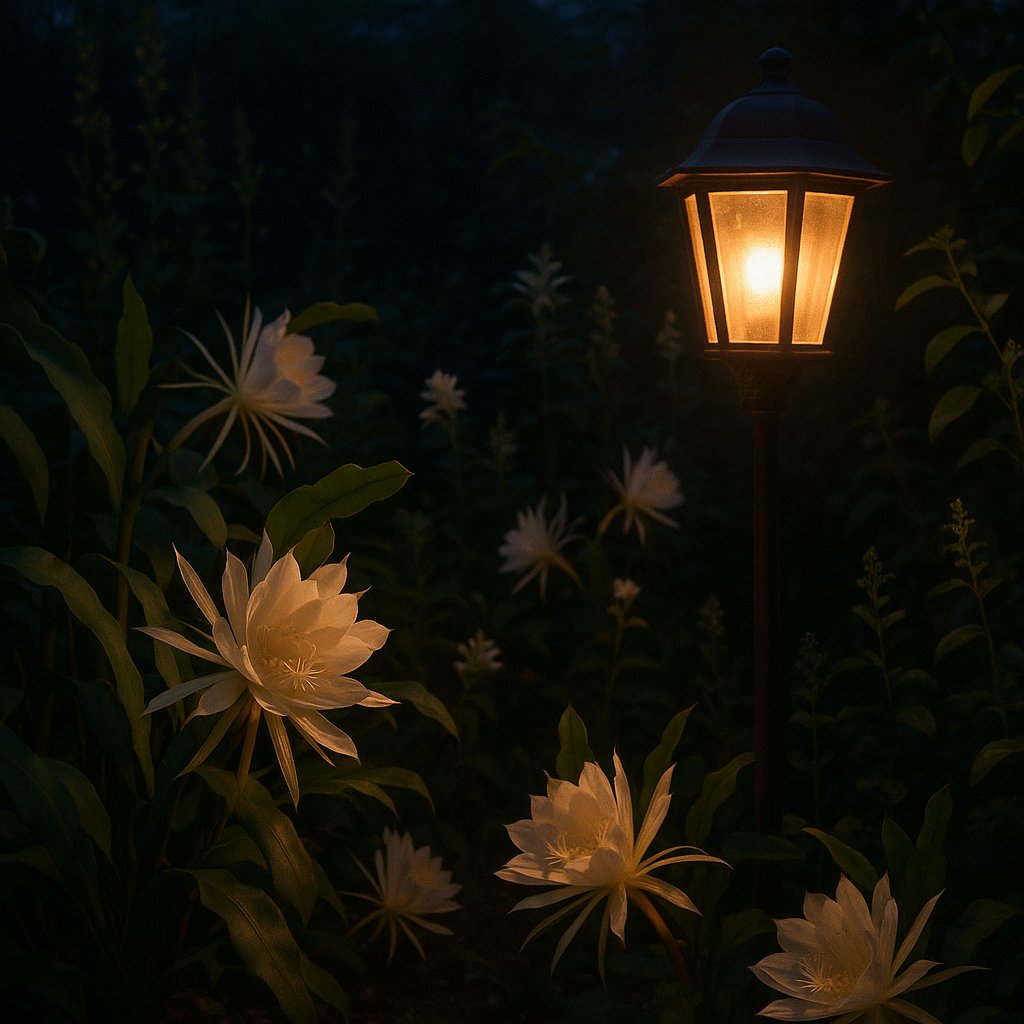
For gardeners growing night-blooming plants, this has practical implications. If your moonflower vine is planted directly under a porch light or near a street lamp, it may receive fewer pollinator visits – and if it’s a species that requires cross-pollination, that means fewer seeds and fruit.
Simple fixes: position night gardens away from strong artificial light, or use warm-toned, low-intensity lighting that’s less disruptive to moths. Red-spectrum lights are generally less attractive to insects than blue-white LEDs.
Bringing the night garden home
If you’re planning a moonlight garden – a space designed to come alive after sunset – think beyond just the flowers. Pair night bloomers with silver-leaved plants like Artemisia or lamb’s ear, which reflect moonlight and create a luminous backdrop. Add a water feature; the sound enhances the sensory experience once you can no longer rely on color.
Placement matters. Position night-blooming species near seating areas, bedroom windows, or paths you walk in the evening. The whole point is to be present when these plants do their work.
For those who want to explore the intersection of botanical knowledge and thoughtful garden design, understanding why a plant blooms when it does isn’t just academic – it changes how you build a garden that truly functions around the clock.
The bigger picture
Night-blooming flowers remind us that the natural world doesn’t operate on our schedule. These plants evolved their rhythms over millions of years, fine-tuning every detail – petal color, scent chemistry, bloom timing, water management – to thrive in a window most of us sleep through.
The next time you step outside after dark, pay attention. That faint sweetness in the air might be a plant that’s been waiting all day for this exact moment – not for you, but for a moth you’ll never see. And there’s something genuinely wonderful about that.
Medicinal properties of calendula and contraindications
“`html
Medicinal properties of calendula: proven benefits, practical uses, and who should avoid it
The first thing you notice isn’t the color — it’s the resin. Pinch a calendula flower head between your thumb and forefinger, and your skin comes away tacky, faintly aromatic, almost pine-like. That sticky residue contains some of the most concentrated plant chemistry you’ll find in any backyard herb garden. I first grew calendula because a neighbor swore it cleared up her eczema — and I was skeptical. A decade later, I keep dried petals in three different jars around my kitchen, and I still think most people underestimate what this flower can do.
But here’s the thing: calendula is not harmless for everyone. Certain people should never swallow it. Others need to patch-test before smoothing it onto skin. This article covers both sides — the genuine medicinal properties of calendula and the contraindications that too many herbal websites bury in a footnote.
What makes calendula medicinal — a look inside the flower
Calendula officinalis is a flowering annual in the Asteraceae (daisy) family. Calendula grows 12–28 inches tall, blooms from late spring through fall, and produces orange-to-yellow ray flowers used in herbal preparations worldwide. The flower head — not the stem, not the leaves — holds the highest concentration of bioactive compounds. So when you buy “calendula” anything, you want petals and whole flower heads, period.
What’s actually inside those sticky petals? A 2023 review published in PMC (Shahane et al.) cataloged the multifaceted therapeutic potential of C. officinalis, and the compound list is impressive:
- Flavonoids (quercetin, isorhamnetin) — flavonoids reduce inflammation and neutralize free radicals in cell and animal studies.
- Triterpenoids (faradiol, arnidiol) — triterpenoids drive much of calendula’s anti-inflammatory and wound-healing power.
- Carotenoids (lutein, beta-carotene) — carotenoids give petals their orange pigment and act as potent antioxidants.
- Saponins — saponins contribute to antimicrobial and immune-modulating activity.
- Volatile oils — volatile oils provide mild antiseptic effects and that distinctive scent you notice in a fresh bouquet.
These compounds rarely work alone. They interact synergistically, which is part of why a whole-flower preparation often outperforms an isolated extract in traditional use. Honestly, that synergy is what surprises me most about calendula — the sum genuinely seems greater than the parts.
Proven healing properties of calendula
Skin repair — burns, cuts, and chronic wounds
Calendula accelerates wound closure by stimulating collagen production and angiogenesis (the growth of new blood vessels into damaged tissue). Multiple cancer centers in the US and Europe now use calendula-based topical preparations for postradiation dermatitis — the painful, peeling skin that radiation therapy leaves behind. A French clinical trial found that patients applying calendula cream experienced significantly less severe skin reactions compared to a standard institutional moisturizer.
Beyond oncology, calendula benefits show up in everyday injuries. Minor burns, shallow cuts, cracked heels, diaper rash — topical calendula supports all of these. In my experience, a calendula salve applied twice daily to a kitchen burn noticeably shortens healing time compared to petroleum jelly alone. That’s anecdotal, sure. But the clinical data backs the general direction.
Anti-inflammatory and pain-relieving effects
Faradiol esters in calendula reduce edema in animal models with an effectiveness that researchers have compared to low-dose indomethacin. Practical translation? Calendula mouthwash can soothe inflamed gums in early-stage periodontal disease. A calendula compress can ease the throbbing of a hemorrhoid flare-up. And calendula oil, massaged gently into sore muscles after a long gardening session, works better than I expected the first time I tried it.
Let’s get real for a second, though: calendula will not replace ibuprofen for acute, intense pain. Calendula’s anti-inflammatory action suits chronic, low-grade inflammation best.
Antimicrobial action — bacteria, fungi, and more
Calendula extracts inhibit Staphylococcus aureus, Candida albicans, and several other common pathogens in laboratory studies. Topical calendula shows promise for minor skin infections and vaginal candidiasis in small clinical trials.
Honest caveat: in vitro results do not always translate to human outcomes. A petri dish is not a person. Still, the antimicrobial profile supports calendula’s traditional role as a first-aid herb, and I think that role is well-earned.
Digestive support — the underrated benefit
Calendula tea soothes gastric mucosa through a demulcent (coating) action that protects irritated tissue from further acid damage. Herbalists across Europe and the Americas use calendula for GERD, peptic ulcers, and inflammatory bowel irritation. Calendula also acts as a mild cholagogue, meaning calendula gently stimulates bile flow and supports fat digestion.
This digestive angle is the gap most wellness blogs ignore. They focus on skin, mention tea in passing, and move on. But in my practice conversations with clinical herbalists, calendula’s gut-healing properties come up constantly — especially for people who want alternatives to long-term proton pump inhibitors. Worth noting: calendula tea for digestive issues pairs well with chamomile and meadowsweet, though you should introduce one herb at a time to track your body’s response.
Antioxidant and hepatoprotective properties
Carotenoids and flavonoids in calendula scavenge free radicals, reducing oxidative stress at the cellular level. Animal studies suggest calendula protects liver tissue from toxin-induced damage — researchers observed lower liver enzyme levels in rats given calendula extract before exposure to carbon tetrachloride. Human clinical data on calendula’s hepatoprotective effects remains limited, so treat this benefit as promising but preliminary.
How to use calendula — practical forms and dosages
Calendula tea
Steep 1–2 teaspoons of dried calendula petals in 8 oz of hot (not boiling) water for 10–15 minutes. Drink 2–3 cups daily for digestive complaints. Taste note: mildly bitter, slightly peppery, with a faint honey-like sweetness that grows on you. I’ll admit the first sip years ago made me wrinkle my nose — now I genuinely enjoy it.
Tincture
Calendula tincture delivers a more concentrated dose than tea. A typical serving runs 1–2 mL (roughly 30–60 drops) three times daily, diluted in a small glass of water. Alcohol-based tinctures extract triterpenoids more efficiently than water alone, making tinctures ideal for anti-inflammatory use.
Oil and salve (topical)
Calendula-infused oil works beautifully for dry skin, minor wounds, and cracked nipples during breastfeeding — topical application only, not oral during lactation. Adding beeswax turns infused oil into a salve, creating a protective barrier that holds moisture against the skin.
Commercial creams and ointments
US health food stores stock several reputable calendula products. Boiron Calendula Cream and Weleda Calendula products are widely available and well-reviewed. Heads up: check ingredient lists carefully, because some commercial creams contain added fragrances or essential oils that may irritate sensitive skin and undermine the very soothing effect you’re after.
| Form | Best for | Typical dose | Onset of effect |
|---|---|---|---|
| Tea | Digestive soothing, mild daily antioxidant support | 1–2 tsp petals / 8 oz water, 2–3× daily | Several days of consistent use |
| Tincture | Anti-inflammatory internal support, immune boost | 1–2 mL (30–60 drops) 3× daily | 1–2 weeks |
| Infused oil / salve | Wound care, dry skin, eczema, cracked nipples | Apply thin layer 2–3× daily | 24–72 hours for minor wounds |
| Commercial cream | Convenient daily skin care, minor irritation | Per product label | Varies by formulation |
Who should NOT use calendula — contraindications and risks
Pregnancy and breastfeeding
Calendula has a long traditional history as an emmenagogue — a substance that stimulates menstrual flow. Oral calendula may increase miscarriage risk by promoting uterine contractions. Pregnant women should avoid internal use of calendula entirely. Topical application on intact skin appears safer, but caution is still warranted, and a conversation with your OB-GYN should come first.
During breastfeeding, topical calendula on cracked nipples is a common recommendation. Just wipe the salve off before nursing, and skip any oral calendula preparations until you’ve weaned.
Allergy to Asteraceae — ragweed, daisies, chrysanthemums
Cross-reactivity is real and more common than people think. Anyone allergic to ragweed, Tagetes marigolds, chamomile, or echinacea should patch-test calendula on a small area of inner forearm before broader topical use. Oral forms carry a higher risk of systemic allergic response. Swelling of the lips or throat after drinking calendula tea demands immediate medical attention — do not dismiss the reaction as “just herbal.”
Drug interactions you should know about
Calendula may potentiate sedative medications such as barbiturates and benzodiazepines. Animal studies have demonstrated mild CNS-depressant activity in calendula extracts, meaning the herb could amplify drowsiness or slow reaction times when combined with prescription sedatives.
Calendula may also interact with drugs metabolized by cytochrome P450 enzymes. People taking blood pressure medication, diabetes drugs, or anticoagulants should consult a pharmacist before adding calendula tincture or tea to their routine. This is not a “maybe someday” kind of warning — the interaction potential is documented enough to warrant a real conversation with your care team.
Before scheduled surgery
Stop calendula in all oral forms at least two weeks before any surgical procedure. Calendula may enhance sedation from anesthesia and affect blood pressure regulation during and after surgery. Tell your anesthesiologist about every herb and supplement you take — they need the full picture.
Children under two
Limited safety data exists for very young children. Gentle topical application of a calendula salve on diaper rash is generally considered safe, but oral use is not appropriate for infants and toddlers. Consult a pediatrician before trying any herbal preparation on a child under two.
Calendula storage and quality tips
Dried calendula flowers retain potency for about one year when stored in an airtight glass jar away from direct light and moisture. Buy whole flower heads rather than powdered calendula — whole flowers reveal adulteration far more easily than a ground product where you can’t inspect the material. Look for vibrant orange color. Dull, brown-tinged petals indicate oxidation and diminished potency.
One more tip: source matters. Calendula grown in well-drained, organic soil without heavy pesticide use produces cleaner, more resinous flower heads. Mountain Rose Herbs and Frontier Co-op both offer USDA-certified organic dried calendula that I’ve been satisfied with for years.
A final thought
Calendula sits in a rare sweet spot — gentle enough to use daily on skin, potent enough to earn a place in clinical wound care, and yet still misunderstood by people who assume “natural” automatically means “risk-free.” The medicinal properties of calendula are real. So are the contraindications. Respecting both sides of that equation is what separates thoughtful herbal practice from wishful thinking.
Before you add calendula tea or tincture to your daily routine — especially alongside prescription drugs — talk to a healthcare provider who understands botanical medicine. And the next time you see those sticky orange flowers at a farmers’ market, go ahead and pick up a bunch. Your medicine cabinet and your garden will both be better for it.
Frequently asked questions
Can I drink calendula tea every day?
Most herbalists consider 2–3 cups of calendula tea daily safe for healthy, non-pregnant adults during short-term use of 2–3 weeks. Longer continuous use should be discussed with a healthcare provider, since safety data on extended daily consumption remains limited.
Does calendula interact with blood pressure medications?
Animal studies suggest calendula may lower blood pressure. Combining calendula with antihypertensive drugs could cause an excessive drop in blood pressure, leading to dizziness or fainting. Monitor your blood pressure regularly and inform your doctor that you are using calendula.
Is calendula the same as the common marigold I see at garden centers?
No. Calendula officinalis (pot marigold) differs from Tagetes species (French and African marigolds) in chemistry, safety profile, and medicinal value. Only Calendula officinalis carries the healing properties discussed in this article. Check the Latin name on seed packets or product labels before purchasing.
Can I use calendula cream on an open wound?
Calendula salves and creams suit clean, superficial cuts and abrasions. Deep, infected, or surgical wounds require professional medical attention before any herbal application. Clean the wound first, then apply a thin layer of calendula salve to the surrounding skin and shallow wound bed.
How does calendula compare to aloe vera for burns?
Both herbs accelerate epithelial repair through different mechanisms. Calendula offers stronger antimicrobial action and collagen-stimulating properties. Aloe vera provides more immediate cooling and hydration. Many herbalists — myself included — recommend layering aloe gel first for relief, then following with calendula salve once the burn has cooled, especially for minor kitchen and sunburn injuries.
“`
Why do petunia leaves curl and dry out
Why do petunia leaves curl and dry out — and how to fix it fast
Last June, I walked out onto my back porch with a cup of coffee and nearly dropped it. My hanging basket of Wave petunias — the one I’d babied since April — looked like something out of a horror movie. Every leaf curled tight like a fist, edges crispy brown, the whole plant begging for mercy. I’ve been growing petunias for over twenty years across Missouri and Georgia, and that moment still stung. So why do petunia leaves curl and dry out when you think you’re doing everything right?
Here’s the good news: petunia leaf curling and drying happen for specific, diagnosable reasons. Almost every single one of them is fixable — often within days. What follows is a cause-by-cause breakdown drawn from real experience, university extension data, and more dead petunias than I’ll ever admit to. Grab your coffee. Let’s figure out what’s happening to your plant.
The quick diagnosis — what curling and drying actually tell you
Petunia foliage doesn’t just wilt randomly. The plant communicates stress through distinct physical signals, and learning to read those signals saves you weeks of guessing. Upward curling tells a different story than downward cupping. Brown tips mean something different from a leaf that crumbles to dust when you touch it.
Before you reach for a bottle of anything, sit with your plant for sixty seconds and match what you see to this table:
| Symptom | Most likely cause | Check first |
|---|---|---|
| Edges curl upward | Heat stress or underwatering | Soil moisture, afternoon shade |
| Leaves cup downward | Overwatering or herbicide exposure | Drainage holes, nearby lawn spraying |
| Tips turn brown and crisp | Low humidity or fertilizer burn | Humidity level, fertilizer schedule |
| Entire leaf dries and crumbles | Fungal disease or root rot | Stem base, leaf undersides |
That single snapshot narrows your search dramatically. Now let’s dig into each cause.
Heat, wind, and drought — the triple threat
When summer turns brutal
Petunias perform best between 60 °F and 85 °F. Push past 95 °F — a normal Tuesday on a Texas porch in July — and petunia cells lose water through transpiration faster than roots can pull it from the soil. The plant’s defense? Curl the leaves inward to reduce exposed surface area. Smart move for survival. Terrible look for your planter box.
I’ve watched entire rows of Supertunias collapse during a 2024 Georgia heat wave that pinned temperatures above 100 °F for nine straight days. Petunia environmental stress at that level is no joke. The fix isn’t complicated, though: rig a shade cloth (30–50% density) for afternoon protection, mulch the top of containers with a half-inch of fine bark to slow evaporation, and move pots off south-facing concrete that radiates stored heat upward like a griddle.
Wind damage most gardeners miss
Strong, dry wind strips moisture from petunia foliage faster than any root system can compensate. The symptoms mimic underwatering — leaf margins curl inward first, then brown and go papery. Hanging baskets on exposed balconies catch the worst of it.
A Pacific Northwest gardener once told me her petunias looked perfect in the morning and wrecked by 4 p.m. The culprit was a wind corridor between two buildings. She moved the basket six feet to the left, behind a railing, and petunia leaf drying stopped within a week. Sometimes the answer is that simple. Group containers together — plants create their own humid microclimate when clustered.
Your watering habit might be the real problem
Underwatering vs. overwatering — they look eerily similar
Both conditions cause wilting and curling foliage on petunias, which makes misdiagnosis dangerously easy. Here’s how to tell them apart: push your finger one inch into the soil. Dry and gritty means the plant needs water now. Soggy and dark means you’ve been too generous, and the roots may be suffocating.
Petunias in hanging baskets often need water every single day during summer — sometimes twice in extreme heat. Petunias in ground beds typically need a deep soak every two to three days. Pot material matters too: petunia leaves in terracotta pots dry out noticeably faster than those in plastic or glazed ceramic, because terracotta wicks moisture through its walls.
Watering petunias correctly means soaking until water runs from the drainage hole, then letting the top inch dry before the next round. Sounds basic. Most curling problems trace back to breaking this one rule.
Water quality matters more than you think
Hard water loaded with calcium and magnesium deposits a white salt crust on the soil surface over weeks. That crust burns fine root hairs and causes petunia leaves turning brown at the edges — classic salt burn. Chlorinated municipal water adds another layer of low-grade root stress.
My recommendation: let tap water sit in an open container for 24 hours so chlorine off-gasses, or collect rainwater when you can. Once a month, flush each container by running three times the pot’s volume of water slowly through the soil. The salts drain out the bottom, and the roots get a fresh start.
Pests that curl petunia leaves overnight
Aphids, thrips, and spider mites — a rogue’s gallery
Petunia pest problems sneak up on you. Aphids cluster on new growth tips and secrete sticky honeydew that attracts sooty mold. Thrips — tiny, slender insects barely visible to the naked eye — rasp open leaf cells, leaving silvery streaks before the foliage curls and distorts. Two-spotted spider mites (Tetranychus urticae) spin fine webbing on leaf undersides and cause stippled, yellow-speckled leaves that eventually curl and drop.
Honestly, this one surprised me early in my gardening life. I once blamed the sun for three solid weeks before I flipped a leaf and discovered a thriving spider mite colony. Hundreds of them. The webbing was so fine I’d missed it every single morning. Now I check undersides first — always.
Targeted treatment without nuking your garden
You don’t need a chemical arsenal. Follow these four steps:
- Blast pests off with a strong water spray from the hose — knock aphids and mites to the ground where predators find them.
- Apply insecticidal soap (Bonide Insecticidal Soap or Safer Brand) every five to seven days, coating upper and lower leaf surfaces.
- Treat spider mites specifically with neem oil concentrate mixed at 2 tablespoons per gallon of water.
- Target thrips with a spinosad-based spray like Captain Jack’s Deadbug Brew, applied in the evening when pollinators aren’t active.
Check leaf undersides weekly. Make it a habit, not an afterthought. Catching petunia pest problems early means the difference between a quick fix and ripping out the whole plant.
Fungal and viral diseases — the silent leaf killers
Powdery mildew and botrytis
Petunia fungal disease often starts quietly. Powdery mildew (Oidium sp.) coats leaves in a white, dusty film — easy to miss when it begins on the lower foliage hidden by blooms. Affected leaves curl, yellow, and dry as the fungus steals nutrients. Botrytis (gray mold) thrives in humid, crowded conditions where air barely moves between stems.
Treatment: remove every infected leaf and bag the debris — don’t compost it. Improve air circulation by spacing containers at least eight inches apart. Apply a copper-based fungicide or chlorothalonil (Daconil) following label rates. Prevention beats treatment every time here.
Tobacco Mosaic Virus and Aster Yellows — when there’s no cure
Tobacco Mosaic Virus (TMV) is a viral pathogen that causes mottled, curled leaves with yellow-green mosaic patterns. TMV has no chemical cure. Aster Yellows Phytoplasma, spread by leafhoppers, distorts growth and turns petunia foliage a sickly yellow-green. Neither disease responds to fungicides or insecticides aimed at the pathogen itself.
Gardeners must pull and destroy infected plants immediately to protect neighboring petunias. Here’s a detail most care guides gloss over: smokers can transmit TMV to petunias through hand contact. Wash your hands with soap before handling plants — especially after touching tobacco products.
Now here’s where it gets tricky. Herbicide drift from nearby lawn treatments containing 2,4-D or Dicamba curls petunia leaves dramatically — extreme downward cupping and stem twisting that appears within 24–48 hours. University of Minnesota Extension data documents this pattern thoroughly. The fix? Move containers at least 50 feet from any treated lawn, and talk to your neighbors about spray schedules.
Nutrient problems that show up in the leaves
Too much nitrogen — yes, overfeeding curls leaves too
Petunia nutrient deficiency gets all the attention, but overfeeding causes just as much curling. Excess nitrogen forces lush, floppy top growth that roots simply can’t sustain with water and micronutrients. Leaf margins burn and curl inward. I see this constantly with gardeners who use slow-release granules in their potting mix AND pour on weekly liquid fertilizer — a double dose the plant never asked for.
The solution: flush the soil thoroughly, skip fertilizer for two weeks, then resume at half-strength with a balanced formula like Miracle-Gro Water Soluble All Purpose (24-8-16) or a true 10-10-10 every 14 days.
Iron, magnesium, and the micronutrient gap
Iron deficiency shows as interveinal yellowing — the tissue between leaf veins turns pale while veins stay green — primarily on young leaves near the branch tips. Magnesium shortage targets older leaves first, with similar yellowing that progresses to curling and browning.
Apply chelated iron (Ironite or similar) according to package directions, or dissolve 1 tablespoon of Epsom salt per gallon of water and use the mixture as a foliar spray. One crucial detail: soil pH above 7.5 locks out iron regardless of how much you add. A basic soil pH test kit costs under $15 at any garden center, and five minutes of testing can save an entire season of petunias.
A weekly petunia care routine that prevents all of this
Petunia care tips work best when they become habits, not emergency responses. Here’s the routine I follow every season:
- Water petunias at soil level each morning before 10 a.m. — early watering reduces evaporation and keeps foliage dry.
- Flip five random leaves every week and inspect the undersides for pests, webbing, or fungal spots.
- Apply half-strength liquid fertilizer every two weeks, alternating with plain water flushes on off-weeks.
- Deadhead spent blooms every three to four days — removing faded flowers redirects energy toward healthy foliage and new buds.
- Flush container soil once a month by running three times the pot’s volume of water through to clear accumulated salts.
Five tasks. Ten minutes a week, maybe fifteen. That routine alone eliminates about 80% of the curling and drying I used to deal with.
Your petunias are tougher than you think
I’ve grown petunias through Missouri ice storms, Georgia heat domes, and a particularly cursed summer when aphids, spider mites, and powdery mildew all showed up in the same hanging basket during the same week. That basket survived. So did my love for growing petunias, somehow.
Most petunia leaf problems reverse themselves within a week once you remove the stress. The trick is acting quickly and acting specifically — not panic-watering, not dumping fertilizer, not spraying everything in sight. Diagnose first. Treat the actual cause. Then step back.
Your petunias want to bloom. Give them half a chance, and they absolutely will.
FAQ
Can petunia leaves recover after curling, or should I remove them?
Mildly curled leaves from heat or underwatering often flatten out within 48 hours once the stress source disappears. Severely dried or diseased leaves won’t bounce back — prune them cleanly with sharp scissors to redirect the plant’s energy toward new, healthy growth.
Do petunia seedlings curl for different reasons than mature plants?
Seedling leaves curl most often from insufficient light intensity, low ambient humidity, or excess nitrogen in starter mix. Gardeners growing under LED panels sometimes place lights too far away, causing leggy stems and curled foliage. Mature petunias curl more frequently from heat, pests, or root-bound stress in undersized containers.
Will neem oil burn petunia leaves if I apply it in the sun?
Yes — neem oil causes phytotoxicity (leaf burn) under direct sunlight. Apply neem solution in the early morning or evening when temperatures remain below 85 °F and the sun sits low on the horizon. Spray both leaf surfaces evenly and allow the foliage to dry before direct light hits the plant.
How do I tell herbicide drift damage from a virus?
Herbicide drift from 2,4-D or Dicamba causes extreme downward leaf cupping and twisted stems within 24–48 hours of nearby lawn treatment. Viral damage develops gradually over one to three weeks, producing mottled color patterns and distorted new growth. Herbicide-damaged petunias sometimes recover as new foliage emerges; virus-infected petunias do not recover and should be removed.
Should I repot a petunia whose leaves are curling in a small container?
Root-bound petunias curl because compacted roots can’t deliver enough water to the foliage. Move the plant to a pot at least 2 inches wider in diameter, fill around the root ball with fresh potting mix containing perlite for drainage, and water thoroughly after transplanting. Most petunias respond to repotting with visible improvement within five to seven days.