Planning a birthday flower surprise from another city
Sending a birthday flower surprise to someone in a different city takes more coordination than ordering for a person down the street. You cannot see when the recipient is home or which entrance is used for deliveries. A few questions asked early, plus a short written plan, close most of those gaps. The order that tends to make sense is schedule first, then colors, then the address, then a quiet confirmation.
Map the recipient’s week before choosing a date
The birthday itself is not always the best day for flowers to arrive. If the person works outside the home, a delivery to a house at noon may sit on a porch for hours. If they work from home, a morning arrival may catch them in a video call, which could be fine or awkward depending on the surprise you want.
Time zones add a small wrinkle. Atlanta is on Eastern Time, so if you are in California, your morning is already afternoon for the recipient. Plan your phone call or text around their clock, not yours.
Ask a roommate, partner, coworker, or family member a few direct questions:
- Will the person be at home or at work on the birthday?
- Are there trips, late shifts, or standing evening plans that week?
- Would an office or a home address be easier for receiving a bouquet?
- Is there a day just before or after the birthday that works better?
Delivery date and time options vary by florist, so read the ordering page closely and ask the shop directly if a window matters to you.

Choosing colors when you cannot ask directly
Start with what you already know. Look at the clothes the person wears often, the colors in their home from video calls, and the photos they post. Someone whose living room is mostly white and wood may like a soft palette. Someone who wears bold prints may enjoy something brighter.
If you are unsure, ask a mutual friend for a single word, such as “bright,” “soft,” or “green.” One word is enough to narrow a catalog. Avoid leaning on color meaning charts. Interpretations differ from person to person, and a friendly mix usually reads as warm without extra symbolism.
Comparing real arrangements helps more than describing colors in words. A catalog page such as this one for birthday flowers in Atlanta shows bouquet styles in photos, so you can screenshot two options and send them to a friend for a quick vote. Names, sizes, and contents differ between shops, so read the details on any page you use.
If the household has pets or someone sensitive to strong scents, tell the florist when you order. They can suggest stems that fit the situation.
Address details that cause missed deliveries
An address that works for the mail carrier may not be enough for a courier carrying a bouquet. Gather the following from a friend or family member, and do not guess:
- The full street address, including apartment, unit, or suite number.
- The name as it appears on the door, mailbox, or building directory. A nickname may confuse the person at the front desk.
- Any gate code, buzzer number, or entrance instructions.
- For offices, the company name, floor, and the name of the person who handles incoming packages.
- A phone number the courier can call if the door is locked.
Check the ZIP code against the USPS lookup tool. Streets in large metro areas often repeat names across neighboring areas, and a wrong ZIP code can send a driver to the wrong place.
Also ask a friend if the building has a front desk, a package room, or a place where flowers can safely sit. Some do and some do not. Add a short delivery note based on the answer.
Confirming details without spoiling the birthday flower surprise
The simplest way to protect the secret is to avoid asking the recipient anything. Use your helper for the address and schedule, and keep the conversation with the birthday person ordinary. If you need the address, ask for their current mailing address without naming the gift.
Use your own email and phone number on the order so confirmations and delivery updates come to you. If you share an account or a family tablet with the recipient, check whose inbox will receive the receipt.
On the card, write your name clearly and keep the message short. If the recipient might not be home, you can ask the florist whether delivery to a neighbor, front desk, or coworker is an option, since this differs by shop and location.
Tonight, write down the date, the full address, two color choices, and the name of the person who can confirm arrival. Send that person a short heads up and ask for a photo text when the flowers show up, so you can call the birthday person with the full story.
The story of the sweet pea: from Sicilian hillsides to English cottage gardens
Picture a Franciscan monk walking the dry hillsides of Sicily in the late 1600s. He notices a small climbing vetch with maroon and violet flowers and a scent so strong it seems out of proportion to the plant. That monk, Francisco Cupani, did more than admire it. In 1695 he sent seeds north, and the plant went on to become one of the most beloved flowers in Britain and North America.
A wildflower with a powerful perfume
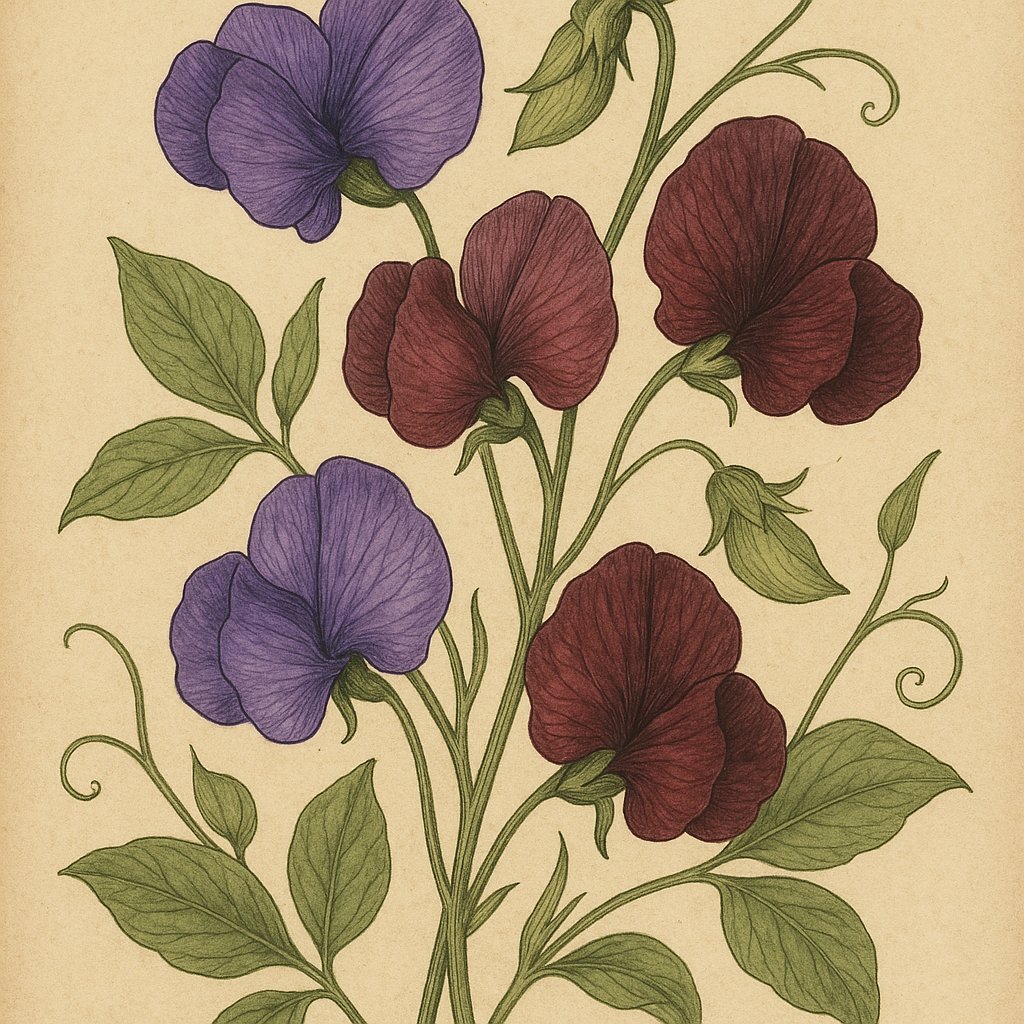
The sweet pea, Lathyrus odoratus, is native to Sicily, southern Italy and some Aegean islands. The wild form is modest. Its flowers are small, usually bicolored in deep purple and maroon, and carried in pairs or threes. What made it special was the fragrance, a mix of orange blossom and honey.
Cupani sent seeds to a schoolmaster in Enfield, England, Dr. Robert Uvedale, and to a Dutch botanist, Casper Commelin. Linnaeus gave the plant its formal name in 1753, and “odoratus” says it all. For the next century or so it stayed a curiosity, grown for scent. A few early color forms appeared, such as the pink-and-white ‘Painted Lady’, which is still grown today.
How a Scottish gardener changed everything
The real transformation began in the 1870s with Henry Eckford, a Scottish nurseryman who moved to Wem, in Shropshire. Over roughly two decades he crossed and selected sweet peas obsessively. He ended up introducing more than 100 named varieties, with larger blooms and a range of colors the plant had never shown before: clear pinks, lavenders, oranges and creamy whites.
By 1900, the plant’s bicentenary in England, sweet peas were fashionable enough to inspire a major show and the founding of the National Sweet Pea Society. Then came a lucky accident. In 1900 and 1901, a gardener at Althorp, the Spencer family estate, spotted a seedling with larger, wavy-edged petals. The ‘Countess Spencer’ type became the template for most of the sweet peas we see now: ruffled, showy and good for cutting. At nearly the same time, other growers in Britain and California found similar mutations. Eckford’s work had made the plant ready for them.
Why it found a home in cottage gardens
Sweet peas suited the English cottage garden almost too well. England’s cool, damp springs are ideal for them. They climb up a bamboo teepee in an afternoon and scramble over fences, and the more you cut, the more they bloom. Cottage gardeners valued plants that were useful as well as pretty, and a jam jar of sweet peas on a kitchen table fit the bill.
The plant crossed the Atlantic early and became a US favorite as well. California’s coastal climate turned out to be ideal for seed production, and the area around Lompoc became a major source of sweet pea seed. Meanwhile, American breeders developed compact types like ‘Cupid’, which suits containers and small spaces.
Growing sweet peas in the US: what actually matters
The plant’s history explains its needs. It evolved in a Mediterranean climate with cool, wet winters, and it hates summer heat. Once nights stay above the 70s °F, flowering slows and the vines fade. In my experience, timing is the main reason people fail with them. Here is what works:
- Sow early. In zones 8–10, plant in fall for spring bloom. In colder regions, sow as soon as the soil can be worked, or start seeds indoors in late winter.
- Give roots room. Use deep pots or paper tubes, because sweet peas resent root disturbance. Cool, rich, well-drained soil is best.
- Pinch young seedlings. When they have three or four pairs of leaves, cut the tip back to encourage branching.
- Support them well. Netting, trellis or a teepee at least 5–6 feet tall will do.
- Cut often. Once pods form, the plant thinks its work is done. Picking every couple of days keeps it flowering.
- Water deeply and mulch. This keeps the roots cool and delays heat stress.
If scent matters most to you, check the variety description. Breeders chasing big ruffled blooms sometimes lost fragrance along the way. Heirlooms such as ‘Cupani’, ‘Matucana’ and ‘Painted Lady’ still carry the old perfume.
One caution: unlike the edible garden pea, sweet pea seeds and pods are toxic if eaten in quantity. Keep them away from children and pets.
A flower worth knowing better
The sweet pea’s journey runs from a monk’s chance find on a Sicilian slope, through a Scottish breeder’s patience and a lucky mutation at an English estate, to backyard fences across America. Its history is a good reminder that many garden favorites began as small wild plants. If you want to go deeper, look into Eckford’s original varieties and heirloom seed collections. Growing a few of the old types next to a modern ruffled one is a good way to see more than 300 years of breeding in a single row.
Flower gifting etiquette in the UAE: what to send and what to avoid
A friend of mine, newly arrived in Abu Dhabi, once sent a huge bouquet of deep red roses to a female Emirati colleague who had just returned from maternity leave. The gesture was kind. The reaction was a polite, slightly puzzled silence. Red roses, a large size, and a male sender added up to a message he never meant to send.
The UAE is warm, hospitable and generous with gifts, but it is also a place where small details carry weight. Nearly 90% of residents are expats, so you’ll often navigate several cultural codes at once. Here is how to give flowers with confidence.
Start with the relationship, not the bouquet
Who you are to the recipient matters more than what is in the vase. A few patterns I’ve noticed over the years:
- Colleagues and business contacts. Keep it modest, elegant and neutral. A mixed arrangement in white, cream or soft pastels works almost anywhere.
- Across genders. Between a man and a woman who aren’t family or close friends, avoid anything that reads as romantic. That means dense red roses, heart-shaped arrangements and oversized displays. If in doubt, address the gift to the whole family or the team.
- Close friends and family. Here you have freedom. Personal taste matters more than protocol.
- Officials and government contacts. Skip anything expensive. Lavish gifts can look like an attempt to influence, and many organisations have strict gift policies. A small, simple arrangement or a card is safer.
Occasions: what works and what to avoid
Emirati social life follows a clear rhythm of celebrations, and flowers fit some of them better than others.
| Occasion | Good choice | Better to avoid |
|---|---|---|
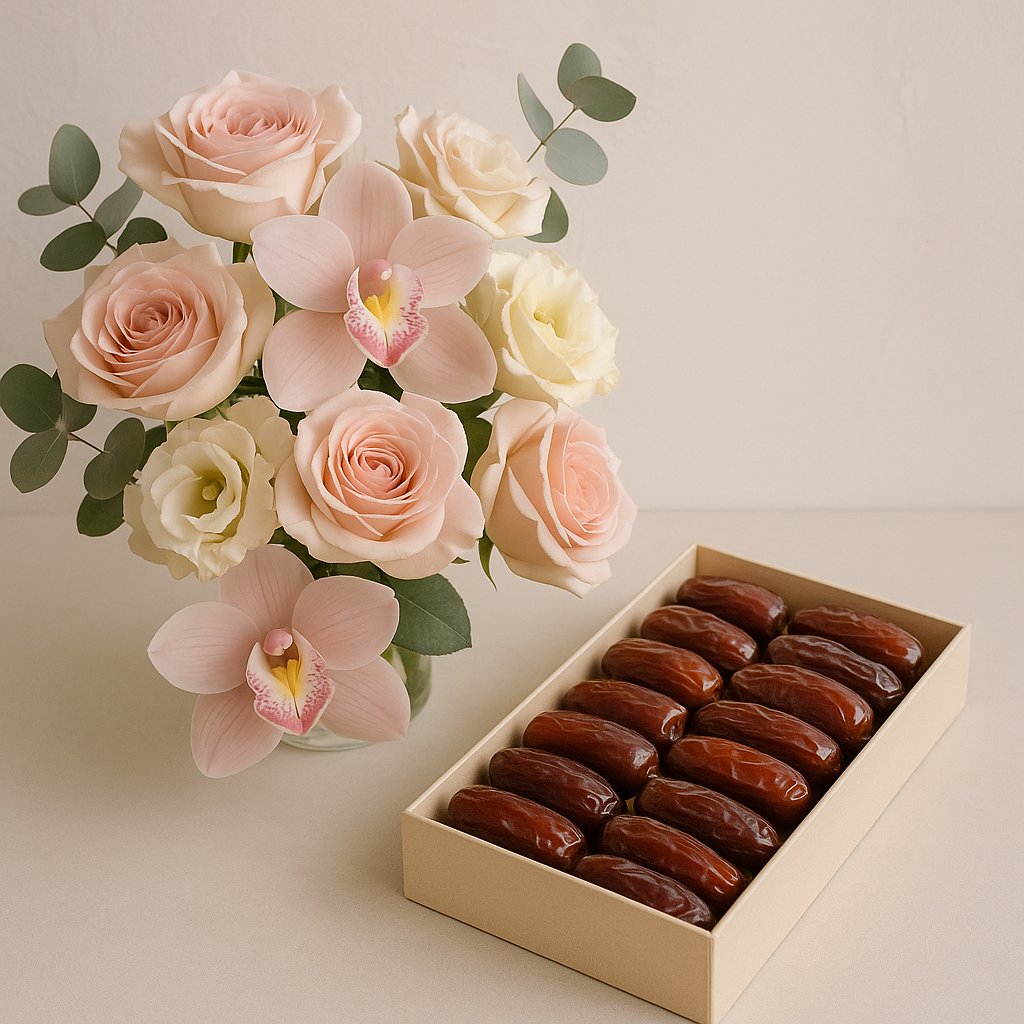
| Eid al-Fitr and Eid al-Adha | Pastel roses, tulips, orchids, often paired with dates or sweets | Dark, heavy palettes; anything with alcohol |
| Ramadan iftar invitation | A small arrangement plus dates or pastries | Arriving with nothing, or with strongly scented flowers that compete with the food |
| Weddings and engagements | White and gold-toned roses, peonies, orchids | Oversized, showy arrangements that upstage the hosts |
| New baby | Soft pink, blue or white, sent to the family | Overpowering lilies near a newborn |
| Hospital visit | Light, low-fragrance stems; check ward rules first | Strong scents, pollen-heavy flowers, anything for ICU |
| Condolences | A note, food for the family, or a donation | Large wreaths for Muslim funerals |
| National Day (2 December) | Red and white blooms with green foliage | Anything that clashes with the national colours in a formal setting |
A word on condolences
This is where I see the most mistakes. Islamic funerals are simple and quick, and floral tributes are not part of the tradition. Families usually appreciate a visit, a heartfelt message, or food sent to the home during the mourning period. If you come from a background where funeral flowers are standard, ask a local colleague before sending anything.
Colour, scent and symbolism across cultures
Because Dubai and Abu Dhabi are so mixed, one bouquet can be read in several ways. White suggests purity and peace for many Arabs, yet it is tied to mourning in parts of South and East Asia. Chrysanthemums are funeral flowers in much of Europe and Asia. Even numbers of stems are a funeral custom for many Russian-speaking residents, who traditionally give odd numbers for celebrations.
My rule of thumb is simple. If you don’t know the recipient’s background, choose mixed arrangements in soft colours, avoid single-colour displays in yellow or deep red, and keep the scent gentle. Orchids, roses, lisianthus and tulips are dependable.
Practical details that people forget
Summer heat changes everything. With outdoor temperatures above 45°C, delicate blooms like hydrangeas and sweet peas wilt quickly, so hardier stems such as orchids, carnations and roses are wiser picks. For gifts you can’t hand over yourself, a reliable flower delivery dubai service can help with timing, but it’s worth checking delivery windows, since a bouquet left in a hot lobby or car won’t arrive looking its best.
A few more points to keep in mind:
- Add a handwritten card. A short, warm message in English or Arabic often matters more than the flowers themselves.
- Skip alcohol pairings. Champagne or wine alongside a bouquet is inappropriate in many settings.
- Consider edible companions. Dates, Arabic sweets or good chocolates are welcome additions, especially during Ramadan and Eid.
- Mind the timing. Avoid delivering during prayer times or late evenings at a private home, and call ahead for workplaces.
- Keep the size proportionate. A huge arrangement can embarrass a recipient in a small office or apartment.
When in doubt, lean toward thoughtfulness
Flower etiquette in the UAE isn’t a rigid rulebook. It’s about showing that you’ve considered the person, the occasion and the setting. Choose soft colours, be careful with romantic signals, treat condolences differently, and pair flowers with something that fits local hospitality, such as dates.
If you want to go deeper, read about Emirati hospitality customs, the traditions around Ramadan and Eid, and the floral habits of the communities you work and live alongside. The more you learn, the easier it becomes to give a gift that feels natural rather than cautious.
Flowers in space: experiments with plant growth on the International Space Station
In January 2016, astronaut Scott Kelly posted a photo on social media that stopped people mid-scroll. It was an orange zinnia – bright, delicate, unmistakably alive – blooming aboard the International Space Station. The image felt almost surreal: a flower, something we associate with backyards and window boxes, floating 250 miles above Earth in a place where nothing is supposed to grow without a fight.
That zinnia wasn’t just pretty. It represented decades of painstaking research, failed attempts, mold outbreaks, and creative problem-solving. And it marked a turning point in how we think about growing plants beyond our planet – not just for food, but for the psychological well-being of humans who may one day spend years traveling to Mars.
Here’s a closer look at how flowers and plants have become a serious area of scientific inquiry aboard the ISS, what we’ve learned so far, and why it matters for life both in orbit and back on the ground.

Why bother growing flowers in orbit?
It’s a fair question. When you’re spending roughly $20,000 per pound to ship cargo to the ISS, why dedicate precious space and crew time to flowers? The answer is twofold – and neither part is trivial.
The science case
Flowering represents a complex stage in a plant’s life cycle. If researchers can get a plant to flower and produce seeds in microgravity, it means they can potentially close the loop on space agriculture – growing multiple generations of crops without needing to send new seeds from Earth. That’s essential for any long-duration mission to Mars or beyond, where resupply simply isn’t an option.
Flowers also serve as biological indicators. The way a plant develops buds, opens petals, and responds to light in zero-g tells scientists a great deal about how fundamental biological processes – hormone signaling, gravitropism, water transport – work when you remove gravity from the equation. Some of these insights have implications for agriculture back on Earth, particularly in understanding how plants respond to environmental stress.
The human case
Astronauts consistently report that tending plants is one of the most calming, grounding activities they can do in space. Don Pettit, who unofficially grew zucchini and sunflowers during Expedition 31 in 2012, kept a blog written from the plants’ perspective. It became a quiet internet sensation. The psychological value of watching something green and alive grow in an otherwise sterile, mechanical environment is hard to overstate.
NASA behavioral scientists have noted that as missions get longer – the current record for an American astronaut is 371 consecutive days – the need for what they call “Earth analogs” becomes more urgent. A small garden, even one that fits inside a container the size of a carry-on suitcase, can help combat the isolation and sensory monotony of spaceflight.
The hardware: Veggie, APH, and the gardens that made it possible
Growing anything in space requires solving problems that simply don’t exist in a terrestrial garden. Water doesn’t drain. It forms floating blobs. Roots can’t “feel” which way is down. Air doesn’t circulate naturally. Every one of these challenges required purpose-built hardware.
Veggie – the workhorse
The Vegetable Production System, nicknamed Veggie, arrived on the ISS in 2014. It’s deceptively simple: a flat panel of red, blue, and green LEDs mounted above a set of plant “pillows” – small bags filled with a clay-based growth medium and controlled-release fertilizer. Seeds are pre-planted in these pillows on the ground, and astronauts just add water and light once they’re in orbit.
Veggie’s footprint is about the size of a small microwave oven. It doesn’t have much environmental control – no humidity regulation, no closed-loop CO₂ management. That simplicity is actually the point. NASA wanted to learn whether plants could handle the ambient conditions of the station, which typically sits around 40–60% humidity with CO₂ levels significantly higher than Earth’s atmosphere (often 2,000–5,000 ppm, compared to roughly 420 ppm on Earth).
The first lettuce crop from Veggie (the VEG-01 experiment) was harvested in 2014 but wasn’t eaten until 2015, after ground teams confirmed it was safe. Since then, crews have grown red romaine lettuce, Tokyo bekana cabbage, mizuna mustard, kale, and – most famously – zinnias.
Advanced Plant Habitat – the precision lab
Where Veggie is a stripped-down garden box, the Advanced Plant Habitat (APH) is a fully enclosed, automated growth chamber. Installed in 2017, it controls temperature, humidity, oxygen, and CO₂ levels independently. It has over 180 sensors and a water recovery system. Its LED array can be programmed to simulate different day lengths and light spectra.
APH was designed for experiments where precise conditions matter – genetic studies, for instance, or investigations into how specific environmental variables affect flowering. The PH-02 experiment used APH to grow radishes, allowing scientists to compare their genetic expression in microgravity to identical plants grown in identical chambers at Kennedy Space Center. The results showed measurable differences in gene activity related to stress responses and nutrient uptake.

XROOTS – ditching the soil entirely
One of the more recent innovations, the eXposed Root On-Orbit Test System (XROOTS), tested hydroponic and aeroponic techniques on the station. The idea was to figure out whether soilless growing methods – which are already common in commercial agriculture on Earth – could scale up for space. Early results were promising, with plants developing healthy root systems without any traditional growth medium.
The zinnia story: when things go wrong (and right)
The VEG-01D zinnia experiment in late 2015 is one of the most instructive episodes in space botany – not because everything went smoothly, but precisely because it didn’t.
Zinnias were chosen because they’re more challenging than lettuce. They need 60 to 80 days to flower (compared to about 28 for lettuce), and they’re sensitive to light, water, and air circulation. NASA wanted to test whether a long-growth-cycle flowering plant could survive the ISS environment.
About two weeks in, things started going sideways. The leaves began curling and showing signs of overwatering. Then mold appeared – Fusarium, a common fungal pathogen. The crew was following a watering protocol designed by ground teams, but the on-orbit conditions were different enough that the schedule didn’t work. Water wasn’t evaporating or draining the way models predicted.
Scott Kelly, drawing on what he described as his own gardening intuition, asked Mission Control for permission to deviate from the set protocol. He got it. He began watering the plants based on his own assessment of soil moisture and leaf condition rather than a fixed schedule. Some plants died. But others recovered. And on January 12, 2016, the first zinnia bloomed in space.
That episode changed how NASA thought about crew autonomy in plant care. The agency realized that for future long-duration missions, astronauts would need to act more like farmers than lab technicians – making judgment calls based on what they see, not just what a protocol says.
What space botany teaches us about plants on Earth
The research has value that extends well beyond spaceflight planning. Here are three areas where ISS plant experiments have contributed to terrestrial science:
- Stress genetics: Plants in microgravity activate stress-response genes that are also triggered by drought, salinity, and extreme temperatures on Earth. Studying these pathways in the “clean” environment of space – where gravity is removed as a variable – helps geneticists isolate which genes do what.
- LED optimization: The LED research done for Veggie and APH has directly informed the rapidly growing indoor farming industry. The specific red-blue light ratios tested on the ISS are now used in commercial vertical farms across the United States.
- Water delivery systems: The capillary-based watering methods developed for microgravity have inspired more efficient irrigation designs for arid-climate agriculture, where every drop counts.
There’s also a less obvious connection. The work on symbiotic nitrogen fixation – explored through experiments with legumes aboard the station – could eventually influence how we reduce fertilizer dependency in conventional farming. If researchers can understand how plant-microbe partnerships function without gravity, they may unlock more efficient ways to harness those partnerships on the ground.
What comes next: flowers on the Moon and beyond
With NASA’s Artemis program working toward a sustained human presence on the lunar surface, plant growth is already part of the planning. The challenge on the Moon is different from the ISS: there’s about one-sixth Earth’s gravity (not zero), intense radiation, and lunar regolith that’s chemically hostile to most plant roots. Researchers at the University of Florida have already shown that plants can germinate in actual lunar soil brought back by the Apollo missions, though the plants were visibly stressed and grew poorly.
For Mars – with a transit time of roughly seven months each way – the focus shifts to closed-loop food production systems. A crew of four would need thousands of calories daily, and current estimates suggest that growing even 25–30% of their food on board could dramatically reduce launch mass and improve morale. Flowering crops like tomatoes, peppers, and strawberries are on the candidate list because they offer both nutrition and variety.
The beauty of the ISS experiments is that they’re building a knowledge base, one crop cycle at a time. Every zinnia that wilts, every radish that thrives, every legume that forms a nitrogen-fixing nodule in zero-g adds a data point that brings future space gardens closer to reality.

Earth gardens, space thinking
There’s something quietly profound about the connection between space botany and the simple act of growing flowers at home. The same principles that NASA researchers wrestle with – light quality, water management, root health, environmental stress – are exactly what any attentive gardener thinks about, just at a different scale.
If you’re someone who finds this intersection of science and horticulture fascinating, it’s worth exploring how deeper knowledge of plant biology can inform your own growing practices. Resources like Orlaya Flora offer a thoughtful perspective on understanding flowers – their needs, their biology, and the sometimes surprising ways they respond to care.
Whether the garden is in your backyard or orbiting 250 miles overhead, the fundamental relationship remains the same: pay attention to what the plant is telling you, adjust accordingly, and don’t be afraid to deviate from the script. Scott Kelly would approve.
Why nasturtium produces many leaves but few flowers
“`html
Why your nasturtium produces loads of leaves but almost no flowers
Picture this: you planted a row of nasturtiums back in May, imagining fiery oranges and deep reds spilling over the edge of your raised bed by July. Fast-forward six weeks, and you’re standing in front of a massive mound of round, lily-pad-shaped leaves. Gorgeous foliage, honestly. But flowers? Maybe two. Maybe none. Why your nasturtium produces many leaves but few flowers is one of the most common — and most frustrating — mid-season mysteries in home gardening. The irony stings, because nasturtium (Tropaeolum majus) ranks among the easiest annuals on the planet. This warm-season flower thrives in USDA zones 2–11, tolerates neglect better than most plants, and blooms from late spring through fall — unless something throws the whole system off balance. Here’s the good news: the fix is almost always simple, and you can usually trigger buds within two to three weeks once you identify the cause.
The #1 culprit — you’re feeding your nasturtiums too well
What nitrogen does to the leaf-vs-flower balance
Nasturtium evolved in the rocky, nutrient-poor slopes of the Andes. That ancestry matters. Rich garden soil confuses the plant’s hormonal signaling, and excess nitrogen is the worst offender. Nitrogen drives vegetative growth — bigger stems, more runners, and those impossibly lush leaves that look like they belong in a tropical greenhouse. The plant channels all its energy into foliage and essentially “forgets” to set flower buds.
I learned this the hard way about fifteen years ago. I tucked nasturtium seeds into a container filled with premium potting mix — the kind labeled “feeds for 6 months.” The result? A wall of green. Zero blooms. I’ve seen the same story retold on Houzz forums and Reddit threads dozens of times since.
Avoid any fertilizer with an N-P-K ratio above 5-5-5. A standard 10-10-10 granular blend delivers roughly twice the nitrogen nasturtium can handle gracefully. Even balanced organic composts, worked generously into the planting hole, can push foliage at the expense of flowers.
The “starve them a little” strategy
Nasturtium flowers best in lean, unfertilized soil. Skip compost around the root zone. Avoid those slow-release potting mixes marketed to container gardeners. Plain garden soil, or a gritty mix of topsoil and perlite, gives nasturtium exactly the kind of mild deprivation that triggers blooming.
Already over-fertilized? Don’t rip the plants out. Flush the container or bed with several deep waterings over a week to leach excess nitrogen, then stop all feeding immediately. Most gardeners who reduce nitrogen see nasturtium blooms reappear within two to three weeks. Patience pays off here — I’ve watched completely flowerless plants explode with buds after a simple feeding freeze.
Not enough sun — the silent bloom killer
Nasturtium requires six to eight hours of direct sunlight daily to form flower buds reliably. Partial shade produces stunning foliage — dark green, oversized, almost sculptural — but suppresses bud initiation at the hormonal level. Many gardeners confuse “bright indirect light” with “full sun.” They’re not the same thing. A spot that feels bright to human eyes may deliver only three or four hours of actual direct rays.
Try this: on a clear day, check your planting spot at 9 a.m., noon, and 3 p.m. Note whether the sun hits the leaves directly or filters through tree canopy. A free sun-calculator app on your phone makes the tracking even easier. Six hours is the minimum threshold. Eight hours is the sweet spot.
One exception worth noting: gardeners in zones 9–10, especially across the Deep South and desert Southwest, benefit from giving nasturtium some afternoon shade. Nasturtium stops setting buds when air temperatures climb above 90°F (32°C). A couple hours of relief from the brutal 2 p.m. sun prevents heat shutdown without starving the plant of light.
Watering mistakes that sabotage blooms
Overwatering triggers leaf growth
Consistent moisture mimics the lush, tropical conditions that favor foliage over flowers. Nasturtium flowers best under mild drought stress — the slight deprivation signals the plant to reproduce, which means buds. Water nasturtiums only when the top inch of soil dries out completely. Stick your finger in. Dry? Water. Damp? Walk away.
Container nasturtiums need faster drainage
Pot material matters more than most people realize. Terracotta breathes and dries faster than plastic. Every container needs at least one drainage hole — no exceptions. Ditch the saucer underneath, or empty the saucer after every watering so roots never sit in standing water. Raised beds filled with sandy, well-draining soil naturally create the mild stress nasturtium craves. Funny enough, the “worst” soil in your yard might be the best spot for nasturtium.
Crowding and spacing — give them room to bloom
Nasturtium plants crammed too closely together compete for sunlight and airflow. Dense foliage shades lower buds before they ever open. Space bush varieties like ‘Jewel Mix’ ten to twelve inches apart. Trailing cultivars such as ‘Tall Single Mix’ need twelve to eighteen inches. Already overcrowded? Thin every other plant. The remaining nasturtiums often respond with a flush of new flower buds within two weeks — the sudden access to light and air acts like a reset button.
Timing and temperature — when nasturtiums actually want to flower
Nasturtium sets buds most aggressively during cooler stretches — late spring and early fall. Midsummer heat above 85–90°F stalls bud formation almost completely, which explains why a plant that bloomed beautifully in June suddenly goes silent in August. Gardeners in zones 7–10 should sow seeds early, as soon as soil temperature reaches 55°F, to maximize the spring bloom window before summer heat arrives.
Cooler zones (3–6) have the advantage here. Nasturtium blooms steadily from June through the first hard frost. A second sowing in late July catches the fall cool-down and delivers a fresh flush of flowers in September — honestly, some of the best nasturtium displays I’ve ever grown came from that late-summer planting.
A quick diagnostic table
| Cause | What you’ll see | Fix |
|---|---|---|
| Over-fertilizing | Huge, dark-green, rubbery leaves and no buds | Flush the soil and stop all feeding immediately |
| Too little sun | Leggy stems reaching toward light, pale leaves | Move containers or thin nearby shade-casting plants |
| Overwatering | Lush, soft foliage and soggy soil surface | Water only when the top inch of soil feels dry |
| Overcrowding | Dense leaf canopy with no visible buds underneath | Thin plants to 10–12 inches apart |
| Heat stress | Wilting at midday, bloom pause despite healthy leaves | Provide afternoon shade and wait for cooler nights below 75°F |
What the leaves themselves tell you
Nasturtium foliage is a surprisingly good diagnostic tool once you know what to look for. Very large, dark-green, almost waxy leaves signal excess nitrogen — the classic all-leaves-no-blooms scenario. Pale or yellowish leaves point to insufficient light; the plant stretches but can’t produce enough chlorophyll energy to trigger buds. Wilting at midday that recovers by evening indicates heat stress, not underwatering — resist the urge to grab the hose.
Here’s the kicker: small, sparse leaves paired with no flowers usually mean the plant faces poor soil and poor light simultaneously. That combination overwhelms even a tough species like nasturtium. Address both issues — relocate to full sun and add a thin top-dress of gritty, low-nutrient soil — and the plant typically rebounds within a few weeks.
Compact cultivars like ‘Empress of India’ display stress signals faster than vigorous trailers, making ‘Empress of India’ an excellent canary-in-the-coal-mine variety for diagnosing garden conditions. I keep a pot of ‘Alaska’ on my patio every year partly for its variegated leaves, partly because the plant tells me instantly when something’s off.
Nasturtium wants to flower — the plant’s entire reproductive strategy depends on producing blooms quickly in poor, sun-drenched conditions. Most of the time, the lack of flowers on nasturtium comes down to us giving too much of a good thing: too much food, too much water, too much shade. Pull back, trust the plant’s Andean instincts, and let a little benign neglect work its magic. Go check your garden this evening. Odds are, the fix is simpler than you think.
FAQ — common questions about nasturtiums not flowering
Can I save an over-fertilized nasturtium, or should I start over?
Flush the soil with deep waterings over five to seven days and stop all feeding. Most nasturtium plants recover and begin producing buds within two to three weeks. Starting over is rarely necessary.
Do nasturtiums bloom in pots as well as in the ground?
Nasturtiums bloom beautifully in containers — often better than in-ground plants, because the gardener controls soil composition and drainage more easily. Use a gritty, nutrient-poor mix and a terracotta pot with drainage holes.
Will deadheading nasturtiums produce more flowers?
Yes. Removing spent blooms prevents seed formation and signals the nasturtium plant to generate new buds instead. Deadhead every few days during peak season for the best results.
My nasturtiums bloomed early then stopped — what happened?
A midsummer heat wave likely paused bud formation. Nasturtium resumes blooming when nighttime temperatures drop below 75°F (24°C). Provide light afternoon shade and wait for cooler weather.
Does the nasturtium variety matter for flower production?
Compact cultivars like ‘Empress of India’ and ‘Jewel Mix’ tend to flower more heavily than vigorous trailing types like ‘Tall Single Mix.’ Trailing varieties channel extra energy into vine growth, so gardeners seeking maximum blooms should choose bush or semi-trailing selections.
“`
What diseases do marigolds repel in the vegetable garden
What diseases do marigolds repel in the vegetable garden — and which claims are overblown?
Last July, I yanked a stunted Roma tomato out of my raised bed in central North Carolina and flipped the root ball over. The roots looked like a string of tiny, grotesque beads — dozens of lumpy galls clinging to every branch. Root-knot nematodes had been feeding all season, and I hadn’t noticed until the plant started wilting in ninety-degree heat. That moment sent me down a research rabbit hole I still haven’t climbed out of: can marigolds actually protect vegetables from diseases like this, or is the whole idea just comforting garden folklore?
Most articles you’ll find on this topic talk about pest insects — whiteflies, aphids, maybe a mention of nematodes — then pivot to how pretty marigolds look along a border. The specific diseases marigolds can suppress, the mechanisms behind that suppression, and the claims that quietly fall apart under scrutiny? Those details rarely show up. This article fills that gap. Every claim here gets graded: strong evidence, emerging evidence, or myth.
The science behind marigold disease protection
Marigold roots are not passive bystanders in the soil. Tagetes species — especially Tagetes patula (French marigold) — produce a group of sulfur-containing compounds called thiophenes. The most studied is alpha-terthienyl, a phototoxic molecule that marigold roots pump continuously into the surrounding soil. Think of alpha-terthienyl as a tiny chemical land mine the roots leave behind: when nematode larvae contact the compound, it disrupts their cellular membranes and kills them. A 2019 review published in the Journal of Nematology confirmed that French marigold root exudates reduce root-knot nematode populations by up to 90 % in controlled greenhouse trials.
Beyond thiophenes, marigold tissue contains allelopathic substances — natural chemicals that suppress competing organisms. When gardeners till spent marigold plants into the soil, the decomposing biomass releases additional antifungal and antibacterial compounds. Researchers at the University of Florida documented measurable reductions in soil-borne Fusarium spore counts after incorporating French marigold residue into test plots. The effect isn’t magic. The chemistry is real, specific, and — critically — species-dependent.
Root-knot nematodes — the disease marigolds fight best
What root-knot nematodes actually do to vegetables
Meloidogyne species, commonly called root-knot nematodes, are microscopic roundworms that live in warm, sandy soils across much of the southern and central United States. Root-knot nematodes pierce root cells and inject saliva that triggers abnormal cell growth, producing the characteristic galls I found on my tomato. Infested plants absorb water and nutrients poorly, wilt under mild stress, and produce smaller harvests. Tomatoes, peppers, carrots, lettuce, okra, and beans all rank among the most vulnerable crops.
The economic damage is enormous. USDA estimates place annual nematode losses for US vegetable growers in the hundreds of millions of dollars. Home gardeners in states like Georgia, Florida, and Texas encounter root-knot problems almost every season — and many don’t realize nematodes are the cause until damage is severe.
Which marigold species suppress nematodes — and by how much
Tagetes patula (French marigold) — an annual that grows 6–12 inches tall — delivers the strongest nematode suppression documented in university trials. French marigolds release alpha-terthienyl from their roots at concentrations high enough to kill second-stage nematode juveniles on contact. The cultivar ‘Nema-Gone’ was bred specifically for this purpose, and it remains a go-to recommendation from extension services across the Southeast.
African marigolds (Tagetes erecta), the tall varieties like ‘Crackerjack’ that reach two to three feet, also suppress nematodes but have fewer controlled studies backing them. Then there’s Tagetes minuta (Mexican marigold), a rangy, strongly scented species that shows moderate nematode-killing activity plus some antifungal properties. I was skeptical of T. minuta until I saw trial results from South African agricultural stations — the plant deserves more attention from US gardeners than it currently gets.
| Marigold type | Target disease / pathogen | Evidence strength | Best vegetable pairing |
|---|---|---|---|
| French marigold (T. patula) | Root-knot nematodes (Meloidogyne spp.) | Strong — multiple university trials | Tomatoes, peppers, carrots |
| African marigold (T. erecta) | Root-knot nematodes, some lesion nematodes | Moderate — fewer controlled studies | Squash, beans, potatoes |
| Tagetes minuta (Mexican marigold) | Nematodes + some soil fungi | Moderate | Row crops, large gardens |
| French marigold (T. patula) | Fusarium oxysporum (soil presence) | Emerging — lab + limited field data | Tomatoes, melons |
| Any Tagetes spp. (as cover crop) | General soil pathogen load | Anecdotal to moderate | Pre-season soil treatment |
How to plant marigolds for maximum nematode control
This is the part most articles skip. Dropping one marigold transplant at the end of each tomato row does almost nothing for nematode suppression. The research is clear: density matters enormously. Plant French marigolds every 7–10 inches in a solid block or dense strip, and let the roots grow undisturbed for at least two to three months. During that time, the root system saturates the surrounding soil with thiophenes.
The most effective approach treats marigolds as a cover crop. Grow a solid bed of French marigolds one full season before planting vegetables in that bed. At the end of the growing season, chop the plants and till all the biomass into the top six inches of soil. The decomposing tissue releases a second wave of nematode-suppressing compounds. Interplanting works too, but it requires enough marigold density to create overlapping root zones — not just a decorative splash of color.
Fungal diseases marigolds may help suppress
Fusarium wilt
Fusarium wilt, caused by Fusarium oxysporum, lives in the soil and can persist for years without a host. The fungus invades tomato, melon, and pepper roots, clogs vascular tissue, and causes irreversible wilting. Lab studies — including a 2021 trial at Nanjing Agricultural University — demonstrated that French marigold root exudates reduce Fusarium spore viability by roughly 40–60 % in culture media.
Here’s the honest caveat: field evidence remains limited. Soil is far more complex than a petri dish, and marigold root compounds encounter competing microbes, variable pH, and inconsistent moisture. Marigolds alone do not replace Fusarium-resistant tomato cultivars. Use marigolds as one layer in a multi-strategy defense — not as the whole plan.
Early blight and other foliar diseases — reality check
Early blight (Alternaria solani) ranks among the most common tomato diseases in the US. You’ll find blog posts claiming marigolds “repel” early blight. I believed a version of this for two seasons before digging into the actual research. Marigolds do not kill Alternaria spores in the air or on leaf surfaces. The compound alpha-terthienyl works in soil, not on foliage.
The indirect benefit is real but modest: marigolds reduce nematode stress on root systems, and plants with healthier roots mount stronger overall defenses against foliar pathogens. Healthier roots support healthier foliage — but calling marigolds a blight cure is a stretch. Proper spacing, mulching, and fungicide-free copper sprays remain more reliable tools for early blight management.
Verticillium wilt and bacterial wilt — where marigolds fall short
Transparency matters more than cheerleading. Marigolds show little to no proven effect on Verticillium dahliae (the fungus behind Verticillium wilt) or Ralstonia solanacearum (the bacterium causing bacterial wilt). Both pathogens operate through vascular invasion, and neither appears sensitive to thiophenes at field-relevant concentrations. Gardeners relying solely on marigolds for these diseases will be disappointed. Crop rotation, resistant cultivar selection, and soil solarization remain the frontline defenses.
Pests that spread disease — marigolds’ indirect shield
Marigold disease protection extends beyond the soil. Several insect pests vector serious viral diseases, and marigolds disrupt those pest populations through trapping, repellence, or predator attraction.
- Whiteflies carry tomato yellow leaf curl virus — French marigolds act as a trap crop, drawing whiteflies away from tomatoes (moderate evidence from Florida field studies).
- Aphids transmit mosaic viruses — French marigolds attract hoverflies whose larvae consume large aphid colonies (well-documented ecological mechanism).
- Thrips vector tomato spotted wilt virus — some greenhouse trials show marigold interplanting reduces thrips populations, though open-field data remains thin.
None of these effects replace row covers or integrated pest management. Still, a dense border of French marigolds gives your vegetable garden an extra biological buffer — and that peppery, almost resinous scent the foliage releases on a hot afternoon? Honestly, it smells like a garden that’s working.
Best placement strategies for disease prevention
Marigold placement determines whether you get real disease suppression or just ornamental window dressing. Dense border rows — two or three marigold plants deep — create a continuous root zone that intercepts nematodes migrating into raised beds from surrounding soil. The downside: border plantings don’t treat soil already infested within the bed itself.
Full-bed cover crop rotation solves that problem. Dedicate one bed entirely to French marigolds for a full growing season, then till the plants in and follow with tomatoes or peppers the next year. A gardener I spoke with at a Master Gardener workshop in Durham, NC, used this rotation on a 4×8 raised bed and reported zero nematode galls on her subsequent tomato crop — the first clean harvest in three years.
Container gardeners and small-space growers can interplant one French marigold for every two to three vegetable plants, spacing marigolds no more than 10 inches from the nearest vegetable stem. In raised beds, the confined soil volume actually concentrates thiophenes more effectively than open ground, so smaller plantings can still deliver measurable results.
Myths worth busting
Honestly, I see these claims recycled every spring on social media, and they set gardeners up for failure.
“Marigolds cure blossom end rot.” No. Blossom end rot results from calcium uptake disruption, usually caused by inconsistent watering. Marigolds have zero effect on calcium availability in fruit tissue.
“Any marigold variety works the same.” No. Tagetes patula dramatically outperforms ornamental signet marigolds (Tagetes tenuifolia) for nematode control. Species selection matters as much as planting density.
“One marigold plant per row is enough.” No. Sparse plantings produce thiophene concentrations too low to suppress nematodes or soil fungi. Density is everything.
Next spring, before you drop a lone marigold seedling at the end of your tomato bed, ask yourself: am I planting enough to actually make a difference? A solid block of ‘Nema-Gone’ French marigolds grown for a full season and tilled into the soil — that’s the single most impactful move a vegetable gardener can make with marigolds for disease prevention. Everything else is a bonus.
Frequently asked questions
Do marigolds kill nematodes or just repel them?
French marigold roots release thiophenes that kill nematode larvae in the surrounding soil. Marigolds do not “repel” nematodes from a distance — the roots must be actively growing in the infested zone for the toxic compounds to reach lethal concentrations.
Can marigolds prevent tomato blight?
Marigolds do not directly kill the Alternaria or Phytophthora fungi that cause blight. By reducing nematode stress on roots, marigolds help tomato plants build stronger overall defenses. Healthier roots support healthier foliage — but marigolds are not a blight cure.
Which marigold variety is best for disease control?
Tagetes patula (French marigold) offers the strongest research-backed nematode suppression. The cultivar ‘Nema-Gone’ was bred specifically for this purpose and remains widely available from specialty seed suppliers. African marigolds (Tagetes erecta) also contribute but carry less trial data.
How long do marigolds need to grow before they suppress soil diseases?
Research shows two to three months of uninterrupted growth produces the greatest thiophene concentration in the soil. Quick transplants that bloom for a few weeks and then get pulled offer minimal disease benefit. Patience is part of the prescription.
Should I till marigold plants into the soil after the season?
Yes. Tilling marigold residue into garden beds releases additional thiophenes and adds organic matter that supports beneficial soil microbes. University of Florida extension trials found that incorporated marigold biomass continued suppressing nematodes into the following growing season — extending protection well beyond the marigolds’ own lifespan.