Picture this: it’s a warm July evening in your backyard. The sun has just dipped below the horizon, the crickets are warming up, and suddenly – a flash of white catches your eye. A tightly wound bud you’ve been watching for days is finally unfurling, petal by petal, releasing a scent so sweet it stops you mid-step. By morning, the flower will be gone.
I’ve watched this happen with a night-blooming cereus on my patio, and honestly, it felt like witnessing something that wasn’t meant to be seen. But here’s the thing – it absolutely was. Just not by me. That flower was performing for an entirely different audience, and every detail of its design – the color, the timing, the fragrance – was calibrated for creatures that come alive after dark.
So why do some plants skip the sunlit hours entirely? The answer is more layered than most articles will tell you. It’s not just about pollinators. It’s about survival strategy, water economics, evolutionary gambles, and a biological clock ticking inside every cell.
The pollinator argument – and why it’s only half the story
Most explanations start and stop here: nocturnal flowers bloom at night to attract nocturnal pollinators. Moths, bats, certain beetles. That’s true, but it undersells what’s actually happening.
Think about the daytime pollination market. It’s crowded. Bees, butterflies, hummingbirds, flies – they’re all competing for the same flowers, and those flowers are competing for the same pollinators. Now imagine a plant that sidesteps this entire frenzy by opening shop when the competition is asleep. Fewer pollinators are available at night, sure, but the ones that do show up – hawk moths, sphinx moths, nectar-feeding bats – have far fewer options. The relationship becomes almost exclusive.
This is what biologists call temporal niche partitioning. Instead of competing in a saturated daytime marketplace, night-blooming plants carved out their own shift. And they adapted every aspect of their biology to dominate it.
How nocturnal flowers “speak” to their pollinators
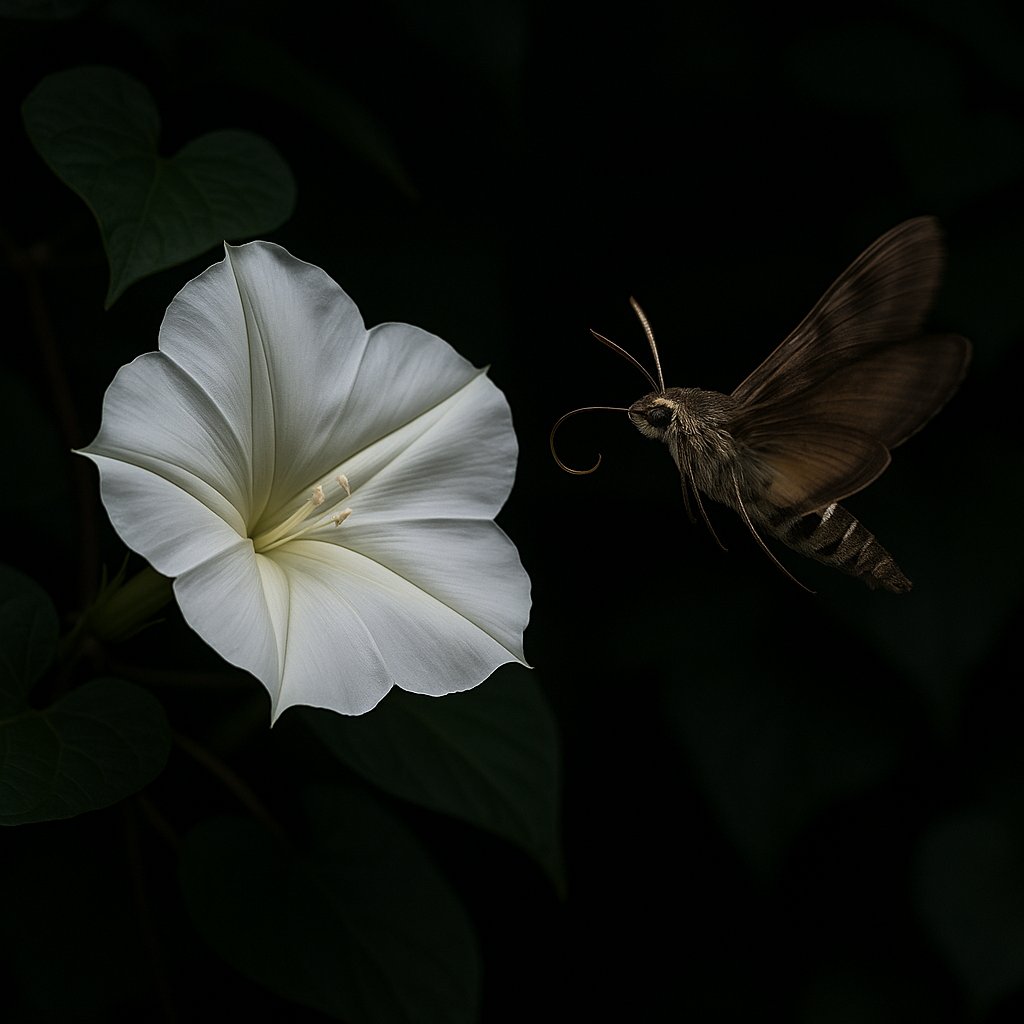
Color is the first giveaway. Notice how night-blooming flowers tend to be white, pale yellow, or cream? In low light, these colors reflect even faint moonlight, making the blooms visible to moths navigating by sight. Dark reds and blues – so attractive to daytime bees – would simply vanish in the darkness.
Then there’s fragrance. Nocturnal flowers don’t just smell nice – they are scent powerhouses. Evening primrose, tuberose, night-blooming jasmine – these plants pump out volatile organic compounds at concentrations that would be overkill during the day. Hawk moths can detect certain floral scents from over a quarter mile away. The flower doesn’t need to be seen first. It needs to be smelled first.
And the shapes tell a story too. Long, tubular corollas are common among night bloomers because they match the long proboscis of sphinx moths. The flower and the pollinator evolved together, each shaping the other over millions of years.
The clock inside the petals
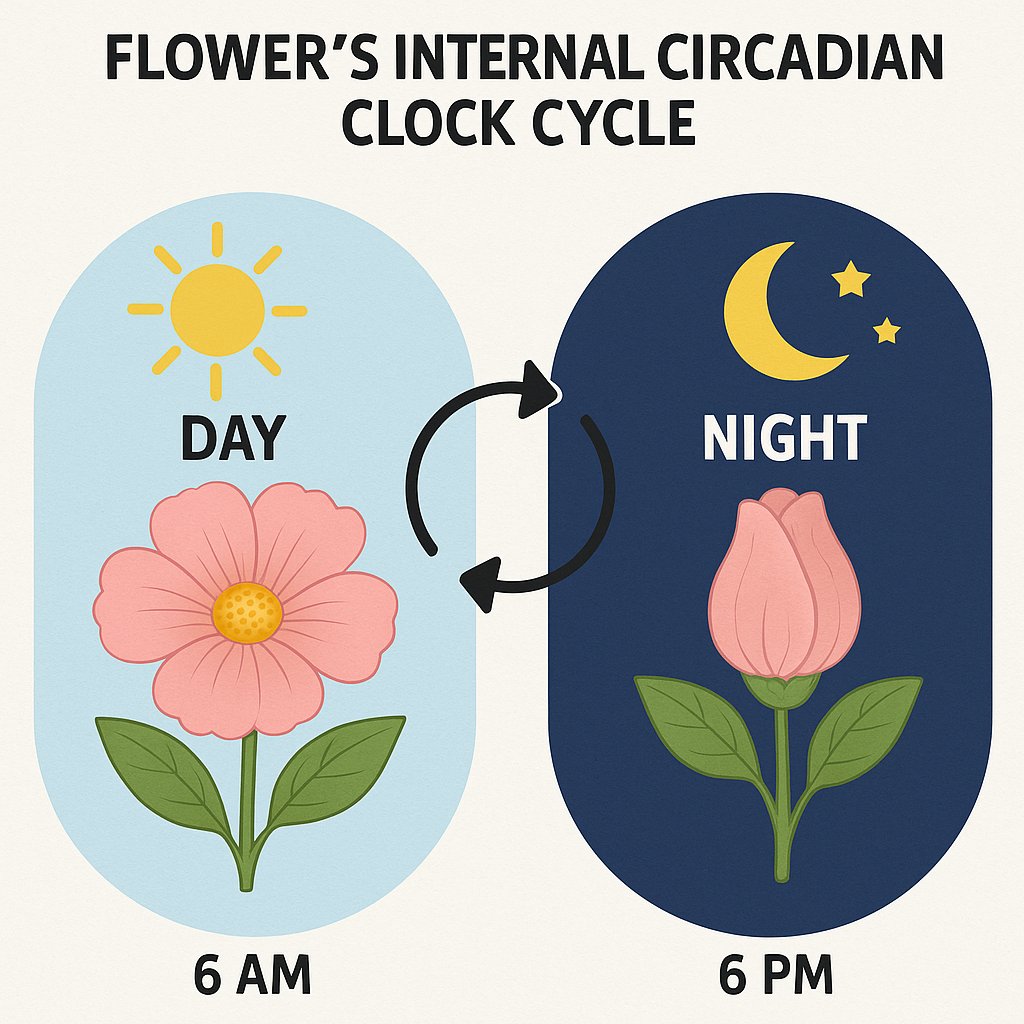
Here’s something rarely explained in depth: flowers don’t simply “react” to darkness. They anticipate it. The mechanism is governed by circadian rhythms – internal biological clocks that cycle roughly every 24 hours, just like in humans.
In plants, these clocks are driven by a set of proteins that rise and fall in concentration throughout the day. Key among them are components of what scientists call the TOC1-CCA1 feedback loop (named after the genes involved in Arabidopsis research but present in various forms across flowering plants). Light resets this clock each morning, but the clock itself keeps running even in constant darkness – proving it’s truly internal, not just a reaction to external light.
What this means practically: a night-blooming cereus “knows” when evening is approaching hours before the sun sets. The biochemical cascade that softens cell walls in the petals, inflates them with water, and triggers scent production begins well in advance. By the time twilight arrives, the flower is ready.
Temperature and humidity play supporting roles
There’s a less-discussed but critical factor: water conservation. Many nocturnal bloomers evolved in arid or semi-arid environments – deserts, dry tropical forests, Mediterranean climates. Opening a flower is an act of water loss. Petals are essentially exposed moist tissue, and during hot, dry daytime hours, evaporation is ruthless.
By blooming at night – when temperatures drop, humidity rises, and evapotranspiration slows – these plants conserve precious moisture. The queen of the night cactus (Epiphyllum oxypetalum) is a perfect example. Native to Central American forests and adapted to dry conditions, it blooms for a single night, closes by dawn, and avoids the punishing midday heat entirely.
This isn’t just about the flower itself. Pollen viability also suffers in extreme heat. Some studies suggest that pollen grains from night-blooming species remain fertile longer because they avoid UV radiation and thermal stress. The plant isn’t just protecting petals – it’s protecting its reproductive future.
Night bloomers you might already have in your garden
Let’s move from theory to the plants themselves. Here are a few worth knowing – some common, some you might not have heard of:
- Moonflower (Ipomoea alba) – A vigorous vine across USDA zones 10–12 (annual elsewhere). Its 6-inch white trumpets open at dusk and close by mid-morning. Easy to grow from seed after nicking the hard coat.
- Evening primrose (Oenothera biennis) – Native to North America and often considered a weed, which is a shame. Its yellow flowers pop open in seconds at twilight – fast enough to actually watch in real time.
- Night-blooming jasmine (Cestrum nocturnum) – The fragrance on this one is almost too much. One bush can perfume an entire yard. Popular in the South but tender below zone 9.
- Four o’clocks (Mirabilis jalapa) – Not strictly nocturnal but crepuscular – they open in late afternoon and stay open through the night. Multicolored, carefree, and often self-seeding aggressively.
- Night-blooming cereus (multiple genera) – The dramatic one. Blooms once a year, for one night. Communities in the Southwest throw “cereus watching parties” to catch the event.
- Dragon fruit cactus (Hylocereus undatus) – Yes, the fruit you buy at the grocery store comes from a night-blooming cactus. The flowers are enormous, fragrant, and last a single night.
One species that deserves more attention is Zaluzianskya capensis, commonly called night phlox or “midnight candy.” Tiny star-shaped blooms, maroon on the back, white on the face, with a scent that genuinely smells like vanilla mixed with honey. It’s underused in American gardens and thrives in containers.
What light pollution is doing to nocturnal blooms
This is the angle almost nobody covers – and it matters.
Research published in Nature in 2017 found that artificial light at night (ALAN) reduced pollinator visits to certain nocturnal flowers by 62%. The light disrupts moth navigation, confuses circadian cues for both plants and insects, and can even suppress scent production in some species. A cabbage thistle study in Switzerland showed that fruit set dropped by 13% under artificial light conditions. Since that initial research, follow-up studies through 2025 have only reinforced the concern, with urban ecologists now listing ALAN as a measurable threat to plant-pollinator networks worldwide.
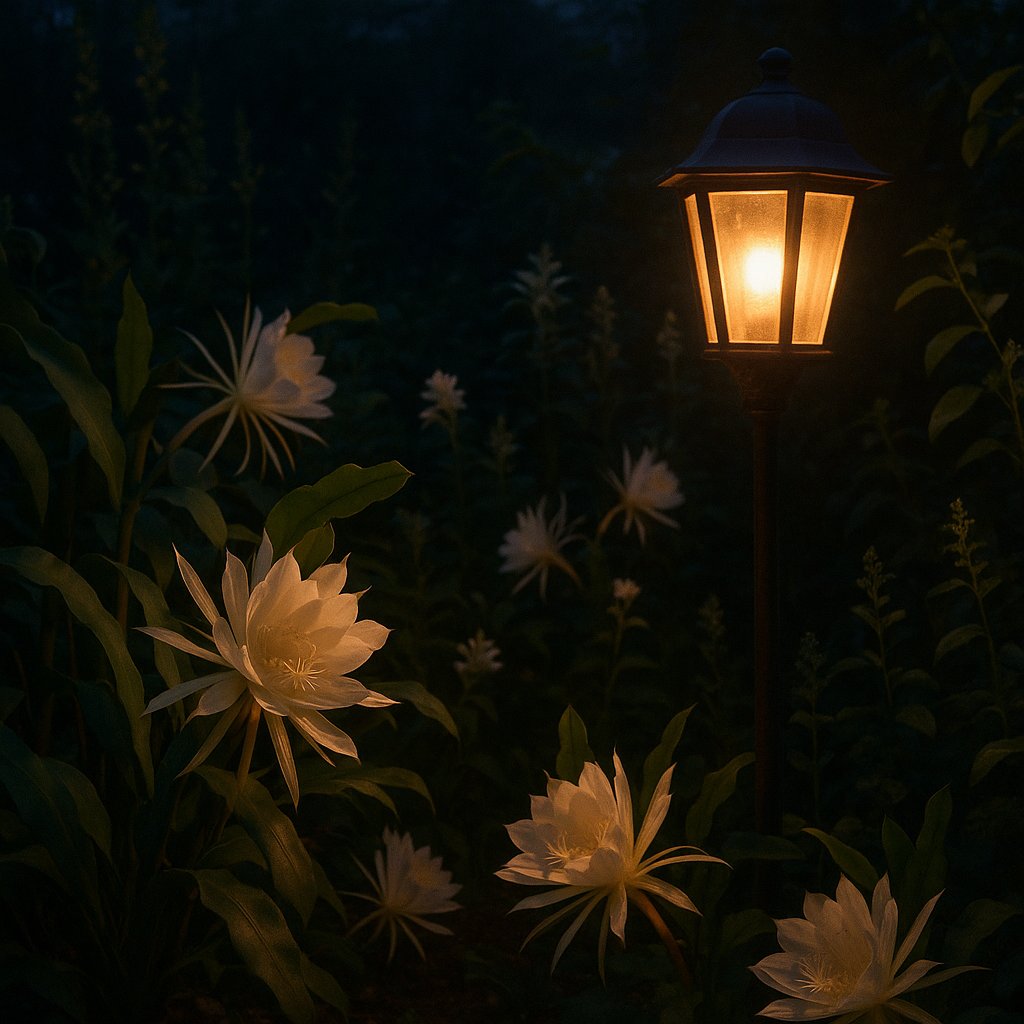
For gardeners growing night-blooming plants, this has practical implications. If your moonflower vine is planted directly under a porch light or near a street lamp, it may receive fewer pollinator visits – and if it’s a species that requires cross-pollination, that means fewer seeds and fruit.
Simple fixes: position night gardens away from strong artificial light, or use warm-toned, low-intensity lighting that’s less disruptive to moths. Red-spectrum lights are generally less attractive to insects than blue-white LEDs.
Bringing the night garden home
If you’re planning a moonlight garden – a space designed to come alive after sunset – think beyond just the flowers. Pair night bloomers with silver-leaved plants like Artemisia or lamb’s ear, which reflect moonlight and create a luminous backdrop. Add a water feature; the sound enhances the sensory experience once you can no longer rely on color.
Placement matters. Position night-blooming species near seating areas, bedroom windows, or paths you walk in the evening. The whole point is to be present when these plants do their work.
For those who want to explore the intersection of botanical knowledge and thoughtful garden design, understanding why a plant blooms when it does isn’t just academic – it changes how you build a garden that truly functions around the clock.
The bigger picture
Night-blooming flowers remind us that the natural world doesn’t operate on our schedule. These plants evolved their rhythms over millions of years, fine-tuning every detail – petal color, scent chemistry, bloom timing, water management – to thrive in a window most of us sleep through.
The next time you step outside after dark, pay attention. That faint sweetness in the air might be a plant that’s been waiting all day for this exact moment – not for you, but for a moth you’ll never see. And there’s something genuinely wonderful about that.